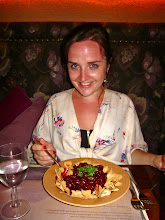
The next morning, we had an early flight back to Fez. The Seville airport was pretty gross compared with the train station, but it served its purpose. We took Ryanair for 5 euros each (plus a bit extra for priority boarding)... but the plane was surprisingly clean and nice. The flight attendants spent the full two hours or so selling lottery tickets and perfume in the aisles, but as long as you don't have baggage or push their buttons in any way, Ryanair is not a bad experience.
It felt strange to be in Morocco again, but also comfortable (we could communicate again!) The road between Fez and Ifrane was all too familiar to us this time, as were the farm workers conked out on the side of the road and the jam-packed grand taxis that swerved past us. We grabbed lunch at a sandwich place in the marche (a $2 lunch again?!) and then returned to an utterly deserted AUI to pick up our luggage. I felt like I knew every nook and cranny of the campus, but it was odd to see it without its people.
Ironically, the only time we were really suckered during our stay in Morocco came when we arrived back in Fez. A taxi driver drove us way out into a corner of the city, then pretended he was lost while the meter was running (when he finally got us back we gave him a pittance). We stayed at the Hotel Royale in the Ville Nouvelle, welcomingly uncomfortable, without a real shower, a toilet down the hall, beds like turtle shells, and a friendly old proprietor. We wound up at a square near the Bab Boujloud, in the shadow of the old city walls. The Ville Nouvelle was visible on the next hillside, and then just open land. In the square, Moroccans had already started to gather in large numbers by late afternoon (but for some reason, not tourists), and there was a traditional storyteller in a signature knit cap surrounded by a crowd of eager shebaab. A ring toss-like game was set up in another corner, and food vendors in another. After shopping in the old medina, we returned later at night to the square to eat little red sausages grilled in front of us and stuffed into the pocket of Moroccan bread, along with a fresh lemon drink. As Sebastien was buying freshly-made potato chips for us, a nicely-dressed man overheard him speaking Arabic and began a long conversation with him. The man was Abdelqader El Kaddany, the father of the potato chip salesman and a teacher of 6th grade French. He invited us to stay at his home for a few days or a week, however long we wanted. As it happened, we had only one day in the country, but we agreed to come for dinner on Monday night. The taxi driver who drove us back to our hotel turned out to have a college degree... in English... but, like so many other well-educated Moroccans, could not find a job other than driving a cab.
When we rose on our last day in Morocco, August 3, we began an epic search for a hammam (traditional bath house). We ended up in corners of the old medina we (and I'm sure most tourists) had never seen before, following all sorts of impossible directions. After it was clear that Lonely Planet failed us, we stopped near the Place Seffarine to watch an old man hammer out combs made from bone. Then we proceeded to Sidi Mohammed's shop near the Bab Boujloud to say our goodbyes to him. He ended up showing us more wonderful things, including 19th century contracts written on pieces of wood, and one on a fat round stick. After chatting for awhile, he invited us to stay with him for lunch in his shop. The meal was homemade by his wife -- a chicken tajine with almonds, a real green salad, and dates, all of which we ate with our hands and bread. Mohammed grunted with pleasure as he ate, and stopped occasionally, grinning widely, to lean in with pearls of wisdom and dramatic exclamations: "You will remember this moment for the rest of your life!" he said at one point (with such gusto that it was thenceforth clear that we would indeed).
After quite some time, Mohammed deposited us at the clothing shop of his bearded friend with the black bruise-like indentation on his forehead that comes from years of prayer. I bought some harem pants for myself and Jenna before we left the old medina and departed for the hammam in the Ville Nouvelle that Mohammed had recommended. The ticket window (10dh per person) was down an unmarked alley. There are separate buildings for men and women, so Sebastien and I parted ways. As soon as I walked into the first room, I realized that I had no clue what I was doing. Several plump women in their 50s or 60s, the attendants, were lounging about on the floor and the wooden benches against the walls. It was Arabic or nothing, so I announced "أول مرة في الحمام" -- "first time at the hammam". I was congratulated repeatedly and given a bowl and pail, but was still clueless. Eventually a girl my age who spoke French showed me the water basins in one of the center rooms -- one cold and one hot. I hadn't brought a mat for the floor, unlike the other women there. I sort of figured out that one fills buckets of hot and cold and mixes them to the desired temperature. That morning, we'd bought the traditional washing materials -- a thick mud-like substance, "black soap", and the kis, a sandpaper-like mitt -- but using them properly and in the right order is another matter entirely. The mitt did successfully slough off layers of dead skin, as promised, but I think the other ladies, gossiping in their corners, must have found my confused dumping of buckets of ice cold water on myself amusing. I cannot deny, though, that when I finally emerged, I felt cleaner than I have in quite awhile. I can't wait to go back (and now I know what to do!)
It was then time for us to meet Mr. Kaddany from the night before. We took a cab with him to his neighborhood, Doccarate, in the Ville Nouvelle. The family's apartment was modest but homey, the neighborhood a complex of square four or five-story whitewashed buildings and a few convenience stores; lots of kids were outside playing. Abdelqader introduced us at the door to three of his four daughters. Hind, the oldest, is 24, and is divorced with one 5-year-old daughter, who lives there, too. The middle daughter, who is 22, left after a short while to return to her husband near Rabat. The third daughter is 20 and is married not far from Fez (she wasn't there). The fourth, Fatema Zahra, is 14 and very friendly. (We also met the mother, but she was ill so we didn't socialize.) No one in the family spoke English, but since Abdelqader is a teacher, he was very patient with our French and Arabic. We were immediately brought piles of melwi and corncakes with fresh butter (this was around 8pm). After a bit, we moved out to mats and pillows on the balcony, discussing America, learning languages, our experiences in Morocco, etc. At one point we went out to get sunflower seeds from the little corner store. Then Hind invited me into the kitchen with her daughter and Fatema Zahra while she made dinner, and we really bonded: we sang "'Alaash Ya Ghuzaali" and "Shemsu Lachia" together. Then she asked me earnestly if I wanted to get married soon (and why not?) and if I wanted to convert to Islam. When I did want to get married, she told me, I should let her know so that she could find a Moroccan and I could move to Morocco! I don't think she or any of the other girls went to college, but she has a pretty good job doing some kind of office work (outside of my vocabulary) and is content for the time being taking care of her daughter. Hind also gave me some uncrushed henna leaves, then used some that had already been partly prepared to do henna for me and Sebastien. Around 11:45pm, dinner was ready -- an excellent sort of pasta dish, but served communal tajine-style, accompanied by fresh-squeezed orange juice. Since we had to be back at our hotel before its "closing" time, we had to depart right away after the meal, walking out to the cab arm and arm, feeling that we'd found a part of real Morocco that maybe we'd missed before -- just before we had to leave for good.
I stayed up all night, fearing that I'd miss our 5am taxi to the Fez airport if I napped. But it gave me time to reflect on our last, and nearly perfect, day in Morocco., as well as on the trip as a whole. After more than 8 weeks in a country (and 9.5 traveling in all), it's not really possible to capture all experiences in a couple of words or even a few sentences: I was in many different places, met all sorts of people, and had both ups and downs for sure. Each week, and each weekend, brought its own surprises. I wasn't sad to come home (and eat a huge green salad), because I felt that I had really had the time to see and experience what I wanted to experience. This doesn't mean that I'm not eager to come back, though -- there's still much more.
The taxi miraculously arrived on time, as promised, just as the dawn call to prayer was sounding. As I waited in the street with my suitcases, old men with white beards and djellabas, with the prayer mark on their foreheads, shuffled past in the near-dark on their way to pray. Otherwise, it was silent. We joked with our driver, who seemed exhausted until he heard our Arabic, on the way to Fez-Saiss Airport, the balmy early morning breeze making this grand taxi ride perhaps the only comfortable one we'd ever taken.
Our flight left on time from the only gate (Gate A, of course). We were on to Casablanca, then New York, then Washington. The adventure was over.
Friday, August 14, 2009

Thursday, August 13, 2009
Part VI: Seville
The bullet train was unbelievably efficient. It took only 45 minutes to get to Seville from Cordoba, the scenery was splendid, and there were attendants walking up and down the aisles with trash bags to ensure the cars remained spotless. Upon arriving, we found space at a charming hostel called "Buenos Suenos" (Sweet Dreams), with a rooftop terrace hung with white linens -- a prime spot for watching the activity in the street below. I had the impression, not quite accurately I suppose, that everything in Seville was yellow and white. It was much busier than Cordoba, but not swarming in tourists as one might fear.
The grand cathedral in the main square was already closed for the day, so we spent some time walking on the adjacent Ave. de la Constitucion, an old but wide street in tip-top shape, sporting a Starbucks, a Fnac, and a cable car. Then we made the first of two visits to the Alcazar, located off the same plaza as the cathedral. From the gate, we couldn't discern the massive size of the grounds -- the entrance was a simple red wall emblazoned with the Castilian lion emblem, from which extendd typical stone castle walls. First erected in the 12th century during the reign of the Almohad dynasty, it was rebuilt by Pedro I in the 14th century; although Pedro was a Christian king, he liked the Islamic style and designed the palace accordingly. It remains the official residence of the Spanish king in Seville to this day. We passed through a series of impressive courtyards adorned with fountains and bountiful vines. Off the courtyards were various chambers, some stuccoed in the Islamic style, others elegantly wallpapered in the European style -- such as one, covered in crimson and gold, where Christopher Columbus supposedly "planned" the discovery of America with Ferdinand and Isabella. To get to the main courtyard, I walked through a winding tiled passageway. At the other end was the heart of the castle complex, a narrow, still pool stretching from one side to the other and flanked by sunken orange trees. It wasn't large, but serene, surrounded by columns supporting perhaps twenty scalloped arches, exquisite stucco work, and an upper arcade that looked much more like Renaissance Italy than 12th century Morocco. The architectural styles blend seamlessly, with each Romanesque arch playing off the neighboring Islamic one. At this point my camera died, so the rest of what I saw is in my mind alone. No furniture is left, but each room off the main courtyard has a ceiling more unusual than the next -- stars and flowers painted in purples, reds, and greens, somehow meshing perfectly with the blue and green tiled walls. The Court of the Dolls was one of my favorite rooms, a small square space with slightly disturbing doll faces carved into the base of the arches. The entry to another room was made quite impressive by two enormous wall peacocks.

But more impressive than that were the real peacocks in the gardens outside. The gardens were literally endless. Each had a name, like "Garden of the Maidens" and a different character -- wispy cypresses or tight beds of roses. One could wander for hours (and the next day, we did) and never find an exit. My favorite garden featured an overgrown pond with an oozing rock, a face carved into it, emerging from its depths: Mount Parnassus. The first crowd of peacocks were strutting around a grassy shaded area, completely undeterred by the occasional human in close proximity. As the gardens closed for the evening and I wandered out, I passed a pergola covered in grape vines. A pair of peacocks, a cobalt blue male and a brownish female, were preening themselves beneath it.
As we sat outside the Alcazar, a pervasive teenager girl hustled me into taking a twig for good luck from some saint (she claimed), then read my palms... in Spanish. For a price of course. We then crisscrossed the ritzy shopping district in search of last-minute tickets for Sara Baras, one of the most famous flamenco stars in Spain - to no avail. In the end we ended up at a rickety table at Alvaro Peregil, a phenomenal tapas restaurant on the street leading to the cathedral (and in view of it). We tried salmorejo there, a type of gazpacho for which Andalucia (and this restaurant) are famous.
Later on, trying again but failing to find flamenco, we wound up at the University of Seville, following a bubbly crowd inside to a large open area with a stage and hundreds of chairs. The stars were bright, the weather balmy, and the attendees eager... but we had no clue what was going on, since the sign had been in Spanish. We sat for quite some time, guessing that maybe it was a boxing match or something. Eventually we determined that it was a comedy show (in Spanish) and gave up.
The next day, we had orange juice and toast at a sidewalk cafe outside our hostel and headed over to the great Cathedral of Seville. Like most sites in Spain (much more than in the U.S. -- in fact, many things were free), the Cathedral had a great student discount. Completed in the 16th century to demonstrate Seville's wealth after the Reconquista, it is the largest Gothic cathedral in the world (with some Renaissance elements) and the third largest cathedral of any era. There were perhaps eighty small chapels, dripping in gold and enormous paintings, around the sides, a large sacristy, and all sorts of surprises that meant it took several hours to even give a cursory look to everything. One whole side had been taken over by a group of miners on a hunger strike, their cots and suitcases laid out all over the floor for the long haul. Some of the highlights included one of the two organs, stretching nearly floor to ceiling in the center of the church: it was so frilly as to appear almost to have been carved from lace, rather than dark wood. I've seen many churches, but the altarpiece in the Capilla Mayor in the center of the cathedral was staggering - the masterpiece of a single craftsman and the largest altarpiece in the whole world. Towering above human height, it oozes with gold and 45 carefully carved scenes from the life of Christ. Another highlight, which I stumbled upon unknowingly at first, was the tomb of Christopher Columbus, a sculpted casket held by four pallbearers. His remains traveled the world for centuries before finally arriving back in Seville. It also struck us that there was a subtle but clear Islamic influence in the church, recognizable in its overlapping arches. It turned out that the cathedral was indeed built over a mosque, and the minaret was converted into a tower (the Giralda). The top of the tower provided views of every corner of Seville, including La Maestranza, the bullfighting arena. Back inside, the official royal chapel was closed for private worship. But we did rest for a bit in the orange tree courtyard, another remnant of the cathedral's Islamic predecessor.


We ate lunch at El Serranito, which served... serranito. A Sevillian specialty, serranito is a cut of pork tenderloin inside a long sandwich bun with a slice of serrano ham (like prosciutto) on top. The meal was only 3 euros and the restaurant, near La Maestranza, had mounted bulls' heads and pictures of toreros all over the walls. Naturally our next stop was La Maestranza itself, in the Arenal district. There were no bullfights that night (sort of a relief), but we went on a tour of the arena. Everything was white with the classic yellow ochre trim of Seville, a perfect match with the impeccably groomed yellow sand inside the arena, and crimson-colored gates. The seating is almost entirely open-air, and at the top are dozens of round arches. Our red-skirted guide explained that the modest gate at one corner was the entrance point for the torero, while the more elaborate marble-columned exit was used only to carry him out in glory when he nailed a special prize (certain combinations of ears and tail). That hadn't happened yet this year. Inside the museum area, we looked at the chic outfits worn by star fighters, the red and white pom-pommed saddles worn by the mules brought out to prepare the bull, and alternative games used to train horsemen when bullfighting (originally done on horseback exclusively) was still just a technique for training the military. Also, I learned that bulls are colorblind and the pink, blue, and red capes used are simply a tradition. Finally, we visited the chapel of the bullfighters where they go to pray just before the fight.

We took a nice stroll along the shady Rio Guadalquivir to the Torre del Oro, built in the Almohad era and so named for the golden yellow tiling on its little dome. Then I visited the Hospital de la Caridad, a serene and little-visited site (I was alone there) and now a home for the elderly. It was built in the 17th century as a home for the destitute by Don Miguel Manara and the Brothers of Charity. They adopted as part of their mission the burying of those executed and those found dead floating in the nearby river. There was a leafy yellow-painted courtyard that led into the fairly small but wildly elaborate chapel. It was covered in paintings by the famous Spanish painter Murillo, mostly depicting Biblical scenes that demonstrate the importance of charity. The pulpit was held up by a remarkable amphibious gargoyle, and the back of the chapel was flanked by two moving paintings by Valdes Leal on the transience of life.

We returned to the Alcazar gardens where we frolicked with baby peacocks this time and wandered through the roses. As we emerged, a wedding was just letting out of the great cathedral, and rose petals had been sprinkled onto the square. We ate diner nearby and then began another fruitless odyssey for flamenco, during which we had the pleasure of exploring many of the back cobbled streets of Seville.
The grand cathedral in the main square was already closed for the day, so we spent some time walking on the adjacent Ave. de la Constitucion, an old but wide street in tip-top shape, sporting a Starbucks, a Fnac, and a cable car. Then we made the first of two visits to the Alcazar, located off the same plaza as the cathedral. From the gate, we couldn't discern the massive size of the grounds -- the entrance was a simple red wall emblazoned with the Castilian lion emblem, from which extendd typical stone castle walls. First erected in the 12th century during the reign of the Almohad dynasty, it was rebuilt by Pedro I in the 14th century; although Pedro was a Christian king, he liked the Islamic style and designed the palace accordingly. It remains the official residence of the Spanish king in Seville to this day. We passed through a series of impressive courtyards adorned with fountains and bountiful vines. Off the courtyards were various chambers, some stuccoed in the Islamic style, others elegantly wallpapered in the European style -- such as one, covered in crimson and gold, where Christopher Columbus supposedly "planned" the discovery of America with Ferdinand and Isabella. To get to the main courtyard, I walked through a winding tiled passageway. At the other end was the heart of the castle complex, a narrow, still pool stretching from one side to the other and flanked by sunken orange trees. It wasn't large, but serene, surrounded by columns supporting perhaps twenty scalloped arches, exquisite stucco work, and an upper arcade that looked much more like Renaissance Italy than 12th century Morocco. The architectural styles blend seamlessly, with each Romanesque arch playing off the neighboring Islamic one. At this point my camera died, so the rest of what I saw is in my mind alone. No furniture is left, but each room off the main courtyard has a ceiling more unusual than the next -- stars and flowers painted in purples, reds, and greens, somehow meshing perfectly with the blue and green tiled walls. The Court of the Dolls was one of my favorite rooms, a small square space with slightly disturbing doll faces carved into the base of the arches. The entry to another room was made quite impressive by two enormous wall peacocks.

But more impressive than that were the real peacocks in the gardens outside. The gardens were literally endless. Each had a name, like "Garden of the Maidens" and a different character -- wispy cypresses or tight beds of roses. One could wander for hours (and the next day, we did) and never find an exit. My favorite garden featured an overgrown pond with an oozing rock, a face carved into it, emerging from its depths: Mount Parnassus. The first crowd of peacocks were strutting around a grassy shaded area, completely undeterred by the occasional human in close proximity. As the gardens closed for the evening and I wandered out, I passed a pergola covered in grape vines. A pair of peacocks, a cobalt blue male and a brownish female, were preening themselves beneath it.
As we sat outside the Alcazar, a pervasive teenager girl hustled me into taking a twig for good luck from some saint (she claimed), then read my palms... in Spanish. For a price of course. We then crisscrossed the ritzy shopping district in search of last-minute tickets for Sara Baras, one of the most famous flamenco stars in Spain - to no avail. In the end we ended up at a rickety table at Alvaro Peregil, a phenomenal tapas restaurant on the street leading to the cathedral (and in view of it). We tried salmorejo there, a type of gazpacho for which Andalucia (and this restaurant) are famous.
Later on, trying again but failing to find flamenco, we wound up at the University of Seville, following a bubbly crowd inside to a large open area with a stage and hundreds of chairs. The stars were bright, the weather balmy, and the attendees eager... but we had no clue what was going on, since the sign had been in Spanish. We sat for quite some time, guessing that maybe it was a boxing match or something. Eventually we determined that it was a comedy show (in Spanish) and gave up.
The next day, we had orange juice and toast at a sidewalk cafe outside our hostel and headed over to the great Cathedral of Seville. Like most sites in Spain (much more than in the U.S. -- in fact, many things were free), the Cathedral had a great student discount. Completed in the 16th century to demonstrate Seville's wealth after the Reconquista, it is the largest Gothic cathedral in the world (with some Renaissance elements) and the third largest cathedral of any era. There were perhaps eighty small chapels, dripping in gold and enormous paintings, around the sides, a large sacristy, and all sorts of surprises that meant it took several hours to even give a cursory look to everything. One whole side had been taken over by a group of miners on a hunger strike, their cots and suitcases laid out all over the floor for the long haul. Some of the highlights included one of the two organs, stretching nearly floor to ceiling in the center of the church: it was so frilly as to appear almost to have been carved from lace, rather than dark wood. I've seen many churches, but the altarpiece in the Capilla Mayor in the center of the cathedral was staggering - the masterpiece of a single craftsman and the largest altarpiece in the whole world. Towering above human height, it oozes with gold and 45 carefully carved scenes from the life of Christ. Another highlight, which I stumbled upon unknowingly at first, was the tomb of Christopher Columbus, a sculpted casket held by four pallbearers. His remains traveled the world for centuries before finally arriving back in Seville. It also struck us that there was a subtle but clear Islamic influence in the church, recognizable in its overlapping arches. It turned out that the cathedral was indeed built over a mosque, and the minaret was converted into a tower (the Giralda). The top of the tower provided views of every corner of Seville, including La Maestranza, the bullfighting arena. Back inside, the official royal chapel was closed for private worship. But we did rest for a bit in the orange tree courtyard, another remnant of the cathedral's Islamic predecessor.


We ate lunch at El Serranito, which served... serranito. A Sevillian specialty, serranito is a cut of pork tenderloin inside a long sandwich bun with a slice of serrano ham (like prosciutto) on top. The meal was only 3 euros and the restaurant, near La Maestranza, had mounted bulls' heads and pictures of toreros all over the walls. Naturally our next stop was La Maestranza itself, in the Arenal district. There were no bullfights that night (sort of a relief), but we went on a tour of the arena. Everything was white with the classic yellow ochre trim of Seville, a perfect match with the impeccably groomed yellow sand inside the arena, and crimson-colored gates. The seating is almost entirely open-air, and at the top are dozens of round arches. Our red-skirted guide explained that the modest gate at one corner was the entrance point for the torero, while the more elaborate marble-columned exit was used only to carry him out in glory when he nailed a special prize (certain combinations of ears and tail). That hadn't happened yet this year. Inside the museum area, we looked at the chic outfits worn by star fighters, the red and white pom-pommed saddles worn by the mules brought out to prepare the bull, and alternative games used to train horsemen when bullfighting (originally done on horseback exclusively) was still just a technique for training the military. Also, I learned that bulls are colorblind and the pink, blue, and red capes used are simply a tradition. Finally, we visited the chapel of the bullfighters where they go to pray just before the fight.

We took a nice stroll along the shady Rio Guadalquivir to the Torre del Oro, built in the Almohad era and so named for the golden yellow tiling on its little dome. Then I visited the Hospital de la Caridad, a serene and little-visited site (I was alone there) and now a home for the elderly. It was built in the 17th century as a home for the destitute by Don Miguel Manara and the Brothers of Charity. They adopted as part of their mission the burying of those executed and those found dead floating in the nearby river. There was a leafy yellow-painted courtyard that led into the fairly small but wildly elaborate chapel. It was covered in paintings by the famous Spanish painter Murillo, mostly depicting Biblical scenes that demonstrate the importance of charity. The pulpit was held up by a remarkable amphibious gargoyle, and the back of the chapel was flanked by two moving paintings by Valdes Leal on the transience of life.

We returned to the Alcazar gardens where we frolicked with baby peacocks this time and wandered through the roses. As we emerged, a wedding was just letting out of the great cathedral, and rose petals had been sprinkled onto the square. We ate diner nearby and then began another fruitless odyssey for flamenco, during which we had the pleasure of exploring many of the back cobbled streets of Seville.
Sunday, August 9, 2009
Part V: Cordoba
The bus ride to Cordoba was beautiful: a patchwork of farms and little white houses spread over rolling hills. When we arrived, we hiked over directly to the Juderia, the historic Jewish quarter and probably the most atmospheric part of the city. The winding cobbled streets were oddly quiet in the warm sunlight of the early evening, the silence interrupted only by the occasional noise of a moped or a barking dog. The whitewashed houses were accented with yellow ochre or mulled crimson trim, and with neat wrought-iron balconies alive with colorful blooms. Our hotel, the "Bagdad Backpackers Hostel" was found in one such building on a side street in the Juderia -- a courtyard home in the Moroccan style with a fountain in the center, tiling, and little blue flowerpots with equally blue flowers hung all over the walls. We wandered just a block or so from the hostel to one of the old walls of the city, then followed the wall to a statue of Maimonides, who was from Cordoba (as were both Seneca and Averroes), and then into a quiet courtyard surrounded by artisans' workshops. Just a few blocks away, almost visible from our hostel, was the Mezquita, for which Cordoba is most famous (more on that later).
Even in the middle of summer, the square around the Mezquita was not awash in tourists. While there is a church-turned-convention center and a city monument sharing the square, the Mezquita looms over them. A bridge dating back to Roman times (thus called the Puente Romano) stretches from the square to the Tower of Calahorra on the other bank of the River Guadalquivir. We watched the sunset from the bridge, then delved back into the streets of the Juderia, settling for dinner on a Lonely Planet-recommended tapas restaurant that proved to be one of our best meals.
The next morning, we decided to hit the Mezquita early, before the crowds. The exterior, an amalgam of Islamic arches and portraits of Christian saints, is only a hint at what lies within. One enters through a traditional Andalucian garden (like that of the Badia palace in Marrakech) called Patio de los Naranjos -- an oasis of orange trees and trickling fountains. From there, we entered the mosque-cathedral itself. The first thing on the site was the Visigothic church of St. Vincent, built in 600 AD. The Muslim caliph Abd ar-Rahman I scrapped St. Vincent's and in 785 began the construction of an enormous mosque. It was expanded and improved over the second several centuries until Ferdinand of Castile captured Cordoba in 1236 and transformed the mosque into a Catholic cathedral. Today, the pamphlets (produced by the Catholic church), fiercely assert that the Mezquita is a church and NOT a mosque -- and indeed there are daily services in the Renaissance-era main chapel. But the Islamic structure is by no means hidden. The building is clearly shaped for Islamic, not Christian prayer: a rectangle with no clear center (the chapel seems to float). It is a sea of jasper, onyx, marble, and granite columns supporting countless red and white striped arches. Semi-circular and mostly pretty simple stained glass windows adorn some corners of the vast structure, with eye-poppingly ornate side chapels and a meticulously carved wooden choir. Several of the chapels have altars tiled in Islamic blues and greens. A scalloped archway leads to the mihrab, which would have been the focal point during the Mezquita's mosque days. The exterior, and the two recesses to either side, glitter with mosaicked Arabic calligraphy and floral patterns. The style is very Byzantine, and in fact many mosaicists were imported from Byzantium to complete the project (they were Christian as it happens). There was also a small exhibit in one area that displayed graffiti, both Arabic and Spanish, left throughout the ages on the pillars. And in another spot, the floor had been cut away to reveal black and white floor mosaics from the original Visigothic church. The cathedral elements were self-consciously extravagant, seeking to assert their superiority over their predecessor, but balanced by the simpler but very picturesque red and white arches that seemed to radiate outward forever. Perhaps neither the mosque nor the cathedral would have been unique on its own, but combined and intertwined, the Mezquita was unlike anything I've seen.
Nearby, and our next stop, was the Palace of the Christian Kings. A palace of some sort has been there since the Roman era, and in fact a section of one of the courtyards had been excavated so that foundations were visible. But most of what you can visit today dates from around 1328 (King Alphonso XI). Most of the stone corridors or nearly empty, but there are wall-sized mosaics in one chamber, baths in another area, and -- the highlight -- a tower. Access was blocked (but who pays attention to those things!) and from the top we could see out to the Mezquita and all across Cordoba, the extensive palace gardens to one side and palms sprouting up between centuries-old buildings to the other. After descending, we explored the gardens, which reminded me of those in Kenneth Branagh's Much Ado About Nothing... rows of perfectly pruned cypresses lining long pools, accented with fuchsia roses and perhaps a statue thrown in for good measure.
We then attempted to visit the Posada del Potro, in the quiet plaza of the same name. The inn briefly played host to Cervantes, who refers to it in Don Quixote. Sadly, it was closed for renovations and we ended up eating a relaxing meal at the plaza instead.
We then departed by train for Seville.
Shots from the Mezquita --


Chilling with Maimonides

Typical building in the Juderia

Even in the middle of summer, the square around the Mezquita was not awash in tourists. While there is a church-turned-convention center and a city monument sharing the square, the Mezquita looms over them. A bridge dating back to Roman times (thus called the Puente Romano) stretches from the square to the Tower of Calahorra on the other bank of the River Guadalquivir. We watched the sunset from the bridge, then delved back into the streets of the Juderia, settling for dinner on a Lonely Planet-recommended tapas restaurant that proved to be one of our best meals.
The next morning, we decided to hit the Mezquita early, before the crowds. The exterior, an amalgam of Islamic arches and portraits of Christian saints, is only a hint at what lies within. One enters through a traditional Andalucian garden (like that of the Badia palace in Marrakech) called Patio de los Naranjos -- an oasis of orange trees and trickling fountains. From there, we entered the mosque-cathedral itself. The first thing on the site was the Visigothic church of St. Vincent, built in 600 AD. The Muslim caliph Abd ar-Rahman I scrapped St. Vincent's and in 785 began the construction of an enormous mosque. It was expanded and improved over the second several centuries until Ferdinand of Castile captured Cordoba in 1236 and transformed the mosque into a Catholic cathedral. Today, the pamphlets (produced by the Catholic church), fiercely assert that the Mezquita is a church and NOT a mosque -- and indeed there are daily services in the Renaissance-era main chapel. But the Islamic structure is by no means hidden. The building is clearly shaped for Islamic, not Christian prayer: a rectangle with no clear center (the chapel seems to float). It is a sea of jasper, onyx, marble, and granite columns supporting countless red and white striped arches. Semi-circular and mostly pretty simple stained glass windows adorn some corners of the vast structure, with eye-poppingly ornate side chapels and a meticulously carved wooden choir. Several of the chapels have altars tiled in Islamic blues and greens. A scalloped archway leads to the mihrab, which would have been the focal point during the Mezquita's mosque days. The exterior, and the two recesses to either side, glitter with mosaicked Arabic calligraphy and floral patterns. The style is very Byzantine, and in fact many mosaicists were imported from Byzantium to complete the project (they were Christian as it happens). There was also a small exhibit in one area that displayed graffiti, both Arabic and Spanish, left throughout the ages on the pillars. And in another spot, the floor had been cut away to reveal black and white floor mosaics from the original Visigothic church. The cathedral elements were self-consciously extravagant, seeking to assert their superiority over their predecessor, but balanced by the simpler but very picturesque red and white arches that seemed to radiate outward forever. Perhaps neither the mosque nor the cathedral would have been unique on its own, but combined and intertwined, the Mezquita was unlike anything I've seen.
Nearby, and our next stop, was the Palace of the Christian Kings. A palace of some sort has been there since the Roman era, and in fact a section of one of the courtyards had been excavated so that foundations were visible. But most of what you can visit today dates from around 1328 (King Alphonso XI). Most of the stone corridors or nearly empty, but there are wall-sized mosaics in one chamber, baths in another area, and -- the highlight -- a tower. Access was blocked (but who pays attention to those things!) and from the top we could see out to the Mezquita and all across Cordoba, the extensive palace gardens to one side and palms sprouting up between centuries-old buildings to the other. After descending, we explored the gardens, which reminded me of those in Kenneth Branagh's Much Ado About Nothing... rows of perfectly pruned cypresses lining long pools, accented with fuchsia roses and perhaps a statue thrown in for good measure.
We then attempted to visit the Posada del Potro, in the quiet plaza of the same name. The inn briefly played host to Cervantes, who refers to it in Don Quixote. Sadly, it was closed for renovations and we ended up eating a relaxing meal at the plaza instead.
We then departed by train for Seville.
Shots from the Mezquita --


Chilling with Maimonides

Typical building in the Juderia

Part IV: Malaga
The decision to stop in Malaga was made just a few days earlier, and we weren't sure it would be too exciting. It was our first real Spanish city, though, and we were pleasantly surprised. We came in at night by bus and found a charming hostel on the bustling Calle Marques de Larios, a cobbled pedestrian thoroughfare that came alive in the evening with itinerant guitar players, clowns, and false statues. The buildings there, as in much of Malaga, were spotless and seemed to have been built yesterday but for their grand old architecture and cheerful but elegant paint jobs.
We ate our first tapas as we were serenaded on guitar and violin, then strolled down the Calle, where a ska band was performing to large crowds. The next morning, after painfully grunting our way through Spanish at the Western Union desk at the local post office, we arrived at the Museo Picasso, the main reason for our visit. Malaga was Picasso's hometown, and the museum, which opened only recently, was located in a (spotless) courtyard building off an equally spotless side street, tastefully accented with flowering fuchsia vines. The museum did not have any of Picasso's extremely famous works, but did have a very large collection, including some of his very early works, before he developed his signature style. Found inside were several of his miniature guitar still lifes and portraits of little owls. One of the more famous is "Bather" (1971), in which the turquoise female subject herself becomes a wave. Two of the special exhibits, though, were the most interesting: the first featured the paper cutouts Picasso used as models for his sculptures, and sometimes produced just as a hobby. The second, my favorite, was a show of Picasso's drypoint, etching, and aquatint prints, some of which, like "The Rape" feature his traditional contorted shapes, while others, like "The Poor" (1905), an etching, are more closely representational. In the basement were various archeological remains from different periods found in Malaga.
We didn't have time for any more sightseeing in Malaga, other than a classy lunch at the museum cafe, since we had to catch another bus to Cordoba.
Typical street view (Calle Marques de Larios) in Malaga

We ate our first tapas as we were serenaded on guitar and violin, then strolled down the Calle, where a ska band was performing to large crowds. The next morning, after painfully grunting our way through Spanish at the Western Union desk at the local post office, we arrived at the Museo Picasso, the main reason for our visit. Malaga was Picasso's hometown, and the museum, which opened only recently, was located in a (spotless) courtyard building off an equally spotless side street, tastefully accented with flowering fuchsia vines. The museum did not have any of Picasso's extremely famous works, but did have a very large collection, including some of his very early works, before he developed his signature style. Found inside were several of his miniature guitar still lifes and portraits of little owls. One of the more famous is "Bather" (1971), in which the turquoise female subject herself becomes a wave. Two of the special exhibits, though, were the most interesting: the first featured the paper cutouts Picasso used as models for his sculptures, and sometimes produced just as a hobby. The second, my favorite, was a show of Picasso's drypoint, etching, and aquatint prints, some of which, like "The Rape" feature his traditional contorted shapes, while others, like "The Poor" (1905), an etching, are more closely representational. In the basement were various archeological remains from different periods found in Malaga.
We didn't have time for any more sightseeing in Malaga, other than a classy lunch at the museum cafe, since we had to catch another bus to Cordoba.
Typical street view (Calle Marques de Larios) in Malaga

Saturday, August 8, 2009
Part III: Gibraltar
The terminus of the ferry was Algeciras, and from there we took a bus to La Linea de la Concepcion, the Spanish city that abuts Gibraltar. As soon as we were off the boat it became clear that our utter lack of Spanish language skills was going to be an issue -- not many Andalucians spoke English, and those who did tried to avoid it. From the bus station in La Linea, we just walked across the border, with not even a glance at our passports.
To get into the heart of Gibraltar Town, it is necessary to walk across the airport's runway: this, paired with the Rock, hung with mist and towering before us, made for quite the dramatic entrance. To enter the quaint old part of town, we went through the "landport" tunnel, emerging in Grand Casemates Square. The British-ness of Gibraltar was immediately palpable, with its signature fire engine red telephone booths, "litter" disposals, and "royal mail" boxes; little red historical plaques graced nearly every building and surface. In the most recent vote regarding Gibraltar's political status (it is self-governing), over 12,000 voted to remain a part of Britain while only 44 voted against. The cobbled Main Street had a significant number of money changing outlets, kitschy stores, and liquor shops, but the prevailing atmosphere was quaint and cheerful: every building seemed to have had a recent paint job, smart red or blue or green shutters, and lovely windowboxes.
We stayed at the Cannon Hotel just off Main Street, and a warm English breakfast was made for us free of charge the next day. Our first stop once we'd settled in that afternoon was the small Gibraltar Museum, which featured the 40,000-year-old Neanderthal skulls found there, histories and paraphernalia relating to various sieges and attacks on the Rock, old photos, and preserved Arab baths. Afterward, we headed over to the Trafalgar Cemetery, where sailors who perished in that battle are buried with flowery epitaphs. The cemetery is just overgrown enough to make for a pleasant and sometimes touching wander.
Dinner was at the Gibraltar Arms in a small square across from the cathedral, and I tried fish and chips for the first time. Then, we made our way to Casemates Square once again, where every Gibraltarian teenager seemed to have congregated and a stage had been set up for a local belly dance/flamenco talent show (many of the performers were young kids).
The next morning we were ready to tackle the Rock. We took the cable car up, which takes only 5 minutes and provides great views of the town and water. As soon as we got out, we glimpsed our first ape! The Barbary Apes of Gibraltar are quite tame (though of course one shouldn't touch them) and were brought here by the British (they're not indigenous). Thanks to a healthy diet, their numbers are skyrocketing. Several at the top Apes' Den were munching on oranges while the babies swung from trees; in other places we saw whole families sitting together, the mother nursing the baby and the father picking lice off the mother ape's back.
From the very top of the Rock, it wasn't possible to see much down below (too much fog), so vertigo was happily avoided. We walked downward, stopping at various promontories along the way as more became visible. Our first major stop was St. Michael's Cave, which was first mentioned in writing by Pomponius Mela in 45AD but was known even earlier to the Greeks, Romans, & Phoenicians. In the 19th century it was a popular site for weddings, and even today there is a theater nestled amongst the looming stalagmites and stalagtites. Light classical music played as we wound our way through the rock formations dramatically lit in reds and greens.
Passing through more ape territory, where one of the furry beasts grabbed my leg, we arrived at the Great Siege Tunnels. The tunnels, built into the side of the rock and tall enough to walk comfortably, were originally built in 1782 during the famous French & Spanish siege of British Gibraltar. Later extended, there was a plaque marking where General Grant had once banqueted. From the tunnels we made our way to the nearby "Moorish Castle", or the Tower of Homage. Building commenced in the 8th century as a signal that the Muslims were in the region to stay, but was rebuilt in its present form after the end of the 30-year Spanish occupation in the early 14th century. The top of the tower provided excellent panoramic views of the port and mountainside.
While this sounds like a rather short jaunt, it actually took us almost 4.5 hours to come down from the top. We took a long lunch before bidding farewell to Gibraltar and heading back into Spain.
Signature telephone booth

View from the side of the Rock

Typical street in Gibraltar Town

With a Barbary Ape

To get into the heart of Gibraltar Town, it is necessary to walk across the airport's runway: this, paired with the Rock, hung with mist and towering before us, made for quite the dramatic entrance. To enter the quaint old part of town, we went through the "landport" tunnel, emerging in Grand Casemates Square. The British-ness of Gibraltar was immediately palpable, with its signature fire engine red telephone booths, "litter" disposals, and "royal mail" boxes; little red historical plaques graced nearly every building and surface. In the most recent vote regarding Gibraltar's political status (it is self-governing), over 12,000 voted to remain a part of Britain while only 44 voted against. The cobbled Main Street had a significant number of money changing outlets, kitschy stores, and liquor shops, but the prevailing atmosphere was quaint and cheerful: every building seemed to have had a recent paint job, smart red or blue or green shutters, and lovely windowboxes.
We stayed at the Cannon Hotel just off Main Street, and a warm English breakfast was made for us free of charge the next day. Our first stop once we'd settled in that afternoon was the small Gibraltar Museum, which featured the 40,000-year-old Neanderthal skulls found there, histories and paraphernalia relating to various sieges and attacks on the Rock, old photos, and preserved Arab baths. Afterward, we headed over to the Trafalgar Cemetery, where sailors who perished in that battle are buried with flowery epitaphs. The cemetery is just overgrown enough to make for a pleasant and sometimes touching wander.
Dinner was at the Gibraltar Arms in a small square across from the cathedral, and I tried fish and chips for the first time. Then, we made our way to Casemates Square once again, where every Gibraltarian teenager seemed to have congregated and a stage had been set up for a local belly dance/flamenco talent show (many of the performers were young kids).
The next morning we were ready to tackle the Rock. We took the cable car up, which takes only 5 minutes and provides great views of the town and water. As soon as we got out, we glimpsed our first ape! The Barbary Apes of Gibraltar are quite tame (though of course one shouldn't touch them) and were brought here by the British (they're not indigenous). Thanks to a healthy diet, their numbers are skyrocketing. Several at the top Apes' Den were munching on oranges while the babies swung from trees; in other places we saw whole families sitting together, the mother nursing the baby and the father picking lice off the mother ape's back.
From the very top of the Rock, it wasn't possible to see much down below (too much fog), so vertigo was happily avoided. We walked downward, stopping at various promontories along the way as more became visible. Our first major stop was St. Michael's Cave, which was first mentioned in writing by Pomponius Mela in 45AD but was known even earlier to the Greeks, Romans, & Phoenicians. In the 19th century it was a popular site for weddings, and even today there is a theater nestled amongst the looming stalagmites and stalagtites. Light classical music played as we wound our way through the rock formations dramatically lit in reds and greens.
Passing through more ape territory, where one of the furry beasts grabbed my leg, we arrived at the Great Siege Tunnels. The tunnels, built into the side of the rock and tall enough to walk comfortably, were originally built in 1782 during the famous French & Spanish siege of British Gibraltar. Later extended, there was a plaque marking where General Grant had once banqueted. From the tunnels we made our way to the nearby "Moorish Castle", or the Tower of Homage. Building commenced in the 8th century as a signal that the Muslims were in the region to stay, but was rebuilt in its present form after the end of the 30-year Spanish occupation in the early 14th century. The top of the tower provided excellent panoramic views of the port and mountainside.
While this sounds like a rather short jaunt, it actually took us almost 4.5 hours to come down from the top. We took a long lunch before bidding farewell to Gibraltar and heading back into Spain.
Signature telephone booth

View from the side of the Rock

Typical street in Gibraltar Town

With a Barbary Ape

Part II: Tangier
On Monday morning, we parted ways and Lars, Sebastien, and I headed into Tangier. It teemed with tourists -- many, it seemed, over from Spain for the day, and harassment was uglier (100-fold when I was briefly walking alone). But, perched at the convergence of the Atlantic Ocean and Mediterranean Sea, it had its own distinct character. At moments in Tangier it felt like everyone was a character in a 19th century mystery novel -- it was a melange of crusty seamen, shrewd shopkeepers, aloof natives (and of course fanny pack-sporting sightseers).
We stayed at Hotel Mamora in the heart of the old medina, though it is an old medina with less color than that of Fez or Chefchaouen. The boys' room looked out on the green rooftops of the mosque next door, and the minaret was so close that the adhaan, when it sounded, seemed to be in the very room. Beyond was the sea, with the shadows of the mountains of Andalucia just visible in the mist. We spent the morning schlepping around to every bank in Tangier for my friend's traveler's checks.
Tangier isn't a relaxing city, and feeling a bit tired, we hired a grand taxi to take us about 20km outside the city to the Cave of Hercules, a grotto abutting the Mediterranean. As is not uncommon, cafes and schlocky shops had been set up in and around the cave, with tiki huts perched on the rocks before the crashing waves. Somewhere there was a monkey show, and a man in the traditional pom-pommed straw hat of the North was grilling kebabs. Outside the cave's entrance was a bizarre "cave painting" (from maybe yesterday) of Hercules, adding to the character of the place. The inside has been hacked out by humans over the eons, but it's hard to say how much. A large natural portal on one side frames the sea.
Back in the city, we stopped for a rest at the Grand Cafe de Paris in the heart of Tangier, the place where people in a bygone time (and to a certain extent today perhaps) went to see and be seen. There wasn't much shopping in Tangier, so I tried to go to a couple museums, but they were all closed. The three of us ended up wandering up an alley where we met a shoemaker, from whom we asked directions to a church we'd heard was beautiful. As per his directions, we returned after dinner (at a cute Levantine restaurant painted all blue) to meet the caretaker. The caretaker, Ahmed, led us around the corner to a nondescript building hidden from the street. It was soon clear that it was a synagogue, not a church, but it hadn't been in the guidebook and we were pleased. While himself a Muslim, he was insistent that my friends don yarmulkahs. The inside was astounding, heaped in gold and rich velvet cloths, hanging candelabras and polished benches. The money, we discerned, comes from rich Jewish patrons in Rabat and Casablanca, though the synagogue hasn't been used since the 1940s. We were also brought upstairs to the women's gallery, which had on display tapestries woven by the congregation during its last century.
The sun doesn't set until quite late, and sunset found us on the roof of our hotel, looking out across the coastline and the open sea. It was a spectacular sunset, accompanied by the chanting of perhaps some Sufi brotherhood in the chambers of the mosque. When at last it was over, we slipped into the street below, bought our ferry tickets for the next day, and walked down to the waterfront. While the coastline is a long string of swanky clubs with neon lights, a large swath of sandy beach has been kept between them and the water.
The next morning, we rose early to have some fresh orange juice and melwi at the waterfront before Sebastien and I bid farewell to Lars and set off from the port of Tangier. We took the fast ferry over to Spain, which took a bit less than two hours and was quite comfortable.
View from the Cave of Hercules

Inside the synagogue

Traditional water seller -- you see these guys all over Morocco

Sunset over Tangier

We stayed at Hotel Mamora in the heart of the old medina, though it is an old medina with less color than that of Fez or Chefchaouen. The boys' room looked out on the green rooftops of the mosque next door, and the minaret was so close that the adhaan, when it sounded, seemed to be in the very room. Beyond was the sea, with the shadows of the mountains of Andalucia just visible in the mist. We spent the morning schlepping around to every bank in Tangier for my friend's traveler's checks.
Tangier isn't a relaxing city, and feeling a bit tired, we hired a grand taxi to take us about 20km outside the city to the Cave of Hercules, a grotto abutting the Mediterranean. As is not uncommon, cafes and schlocky shops had been set up in and around the cave, with tiki huts perched on the rocks before the crashing waves. Somewhere there was a monkey show, and a man in the traditional pom-pommed straw hat of the North was grilling kebabs. Outside the cave's entrance was a bizarre "cave painting" (from maybe yesterday) of Hercules, adding to the character of the place. The inside has been hacked out by humans over the eons, but it's hard to say how much. A large natural portal on one side frames the sea.
Back in the city, we stopped for a rest at the Grand Cafe de Paris in the heart of Tangier, the place where people in a bygone time (and to a certain extent today perhaps) went to see and be seen. There wasn't much shopping in Tangier, so I tried to go to a couple museums, but they were all closed. The three of us ended up wandering up an alley where we met a shoemaker, from whom we asked directions to a church we'd heard was beautiful. As per his directions, we returned after dinner (at a cute Levantine restaurant painted all blue) to meet the caretaker. The caretaker, Ahmed, led us around the corner to a nondescript building hidden from the street. It was soon clear that it was a synagogue, not a church, but it hadn't been in the guidebook and we were pleased. While himself a Muslim, he was insistent that my friends don yarmulkahs. The inside was astounding, heaped in gold and rich velvet cloths, hanging candelabras and polished benches. The money, we discerned, comes from rich Jewish patrons in Rabat and Casablanca, though the synagogue hasn't been used since the 1940s. We were also brought upstairs to the women's gallery, which had on display tapestries woven by the congregation during its last century.
The sun doesn't set until quite late, and sunset found us on the roof of our hotel, looking out across the coastline and the open sea. It was a spectacular sunset, accompanied by the chanting of perhaps some Sufi brotherhood in the chambers of the mosque. When at last it was over, we slipped into the street below, bought our ferry tickets for the next day, and walked down to the waterfront. While the coastline is a long string of swanky clubs with neon lights, a large swath of sandy beach has been kept between them and the water.
The next morning, we rose early to have some fresh orange juice and melwi at the waterfront before Sebastien and I bid farewell to Lars and set off from the port of Tangier. We took the fast ferry over to Spain, which took a bit less than two hours and was quite comfortable.
View from the Cave of Hercules

Inside the synagogue

Traditional water seller -- you see these guys all over Morocco

Sunset over Tangier

Wednesday, August 5, 2009
The Last 10 Days: Part I
Now that I'm safely back in the USA, it's time to catch up on all the adventures of the last ten days of my trip. It will have to be in several installments, since it's difficult to fathom how we managed to fit in so many things in so many places in so little time.
The final exam on Friday morning (July 24th) was more difficult than past exams for the class, but manageable. After it was over, I ate my (thankfully) last meal at the AUI "mat'am", checked out of my room, and headed off with only a small backpack and tote bag in hand.
The First Weekend: Martil, Tetouan, & Ceuta
Sara, Sebastien, Noor, Lars, and I took the train from Meknes to Tangier, and then a grand taxi to Martil, arriving around midnight. Martil is a seaside resort town on the Mediterranean, but largely unvisited by foreign tourists. Sara's beach apartments were just a block up from the beach -- as we stood on her rooftop balcony, we could see the water to our left and the city Tetouan to our right. At night, the lights of Tetouan appeared as a patch of flickering candlelight hovering amidst the hills. Sara's parents met us with freshly-made flan and cookies. Neither spoke English, but we managed reasonably in Arabic.
The next morning we slept in, then experienced a "light" Moroccan breakfast -- heaps of melwi pancakes and corncakes, fresh soft, white cheese that is a regional specialty, fresh honey, and warm butter -- before going for a walk along the beach. It was already very crowded by late morning, papered with cheery parasols. We stopped in at a bookshop with piles and piles of $1 books outside, and I managed to find an old Arabic reader and a "Learn Tamazigh in 10 Days" (from Arabic) book, and a book of poems by Mahmoud Darwish. Inside, almost possible to overlook, was a section of somewhat surprising books (for Morocco), including something like "The Real Story of the American Horrors at Guantanamo" and an uncomfortably heroic packaging of "Mein Kampf."
That afternoon, we were invited to lunch at Sara's main home in Tetouan. Like many of the homes I've seen in Morocco, you couldn't tell much from the outside, but the interior of the living/dining room was exquisitely decorated in royal blue and gold. We watched Al Jazeera a bit with her father before the first course was served -- couscous with boiled vegetables and leben, a yogurty milk drink. Then we had a phenomenal kofta tajine with eggs, as it is often prepared.
Afterward, Sara's high school friend Chaimae met us and brought us around the old medina of Tetouan. Tourists tend to flock to nearby Tangier, so Tetouan was calm and breezy. We wound up in one corner of the medina in the midst of the shops selling fur throw rugs made from animal hides. Behind the stalls was the workshop where they are made, and the proprietor explained to us how it is done, by soaking the hides in large pools of water, brushing, fluffing, etc. We emerged from the medina near the forest green and white royal palace (the colors of the whole city, really). Mohamed VI has a palace in just about every city in Morocco, but he would be celebrating the 10th anniversary of his accession in Tetouan just a few days hence. For this reason, the grand Spanish buildings along the main boulevards were strung with red and green flags and lights. We soon began to notice the festive spirit throughout the country.
That night, we returned to the beach after dark, when it was more empty but not too chilly, to chat.
On Sunday, we finally donned our bathing suits and went to frolic in the water. The color of the water was medium turquoise, the waves were high, and the undertow a bit too strong, but it was the perfect temperature. Eventually we roused ourselves from the sun and sand and hopped in a grand taxi for Ceuta (Sebta), the Spanish-owned city farther up the coast.
The highway to Ceuta ran right along the Mediterranean, and the scene was made even more dramatic by the lines of waving red Moroccan flags every few feet on both sides. We walked across the border (after filling out numerous forms on the Moroccan side, since Morocco is bitter about the continued Spanish possession of the city.) Since it was Sunday, everything was dead... except for the beach, as we later saw. Ceuta feels self-consciously Spanish, with wide boulevards, insistent church bells, and neatly-groomed parks with distinctly European-looking monuments. Mostly we just strolled around and enjoyed the scenic views (and visited a fancy McDonald's, actually, where I had my first real salad in awhile.) But we also went to the old fort. There has been a city on the site for over two thousand years, but it went Portuguese in the early 15th century, the period from which the fort originally dates, and Spanish in the late 16th. The interior courtyard has been populated by upscale cafes and palm trees, with a tiny museum tucked away in the corner. The best views were to be had from the ramparts, where old cannons were stationed, the Spanish flag was flapping, and one could see out to the other major hill of the city and out into the sea. Just outside, some teenage guys were cannonballing off a high bridge into the fort's moat.
Arabic class picture

Salt mines outside the train to the North

Flags waving in Tetouan

At the beach in Martil

On the street in Ceuta

The beach in Ceuta

The final exam on Friday morning (July 24th) was more difficult than past exams for the class, but manageable. After it was over, I ate my (thankfully) last meal at the AUI "mat'am", checked out of my room, and headed off with only a small backpack and tote bag in hand.
The First Weekend: Martil, Tetouan, & Ceuta
Sara, Sebastien, Noor, Lars, and I took the train from Meknes to Tangier, and then a grand taxi to Martil, arriving around midnight. Martil is a seaside resort town on the Mediterranean, but largely unvisited by foreign tourists. Sara's beach apartments were just a block up from the beach -- as we stood on her rooftop balcony, we could see the water to our left and the city Tetouan to our right. At night, the lights of Tetouan appeared as a patch of flickering candlelight hovering amidst the hills. Sara's parents met us with freshly-made flan and cookies. Neither spoke English, but we managed reasonably in Arabic.
The next morning we slept in, then experienced a "light" Moroccan breakfast -- heaps of melwi pancakes and corncakes, fresh soft, white cheese that is a regional specialty, fresh honey, and warm butter -- before going for a walk along the beach. It was already very crowded by late morning, papered with cheery parasols. We stopped in at a bookshop with piles and piles of $1 books outside, and I managed to find an old Arabic reader and a "Learn Tamazigh in 10 Days" (from Arabic) book, and a book of poems by Mahmoud Darwish. Inside, almost possible to overlook, was a section of somewhat surprising books (for Morocco), including something like "The Real Story of the American Horrors at Guantanamo" and an uncomfortably heroic packaging of "Mein Kampf."
That afternoon, we were invited to lunch at Sara's main home in Tetouan. Like many of the homes I've seen in Morocco, you couldn't tell much from the outside, but the interior of the living/dining room was exquisitely decorated in royal blue and gold. We watched Al Jazeera a bit with her father before the first course was served -- couscous with boiled vegetables and leben, a yogurty milk drink. Then we had a phenomenal kofta tajine with eggs, as it is often prepared.
Afterward, Sara's high school friend Chaimae met us and brought us around the old medina of Tetouan. Tourists tend to flock to nearby Tangier, so Tetouan was calm and breezy. We wound up in one corner of the medina in the midst of the shops selling fur throw rugs made from animal hides. Behind the stalls was the workshop where they are made, and the proprietor explained to us how it is done, by soaking the hides in large pools of water, brushing, fluffing, etc. We emerged from the medina near the forest green and white royal palace (the colors of the whole city, really). Mohamed VI has a palace in just about every city in Morocco, but he would be celebrating the 10th anniversary of his accession in Tetouan just a few days hence. For this reason, the grand Spanish buildings along the main boulevards were strung with red and green flags and lights. We soon began to notice the festive spirit throughout the country.
That night, we returned to the beach after dark, when it was more empty but not too chilly, to chat.
On Sunday, we finally donned our bathing suits and went to frolic in the water. The color of the water was medium turquoise, the waves were high, and the undertow a bit too strong, but it was the perfect temperature. Eventually we roused ourselves from the sun and sand and hopped in a grand taxi for Ceuta (Sebta), the Spanish-owned city farther up the coast.
The highway to Ceuta ran right along the Mediterranean, and the scene was made even more dramatic by the lines of waving red Moroccan flags every few feet on both sides. We walked across the border (after filling out numerous forms on the Moroccan side, since Morocco is bitter about the continued Spanish possession of the city.) Since it was Sunday, everything was dead... except for the beach, as we later saw. Ceuta feels self-consciously Spanish, with wide boulevards, insistent church bells, and neatly-groomed parks with distinctly European-looking monuments. Mostly we just strolled around and enjoyed the scenic views (and visited a fancy McDonald's, actually, where I had my first real salad in awhile.) But we also went to the old fort. There has been a city on the site for over two thousand years, but it went Portuguese in the early 15th century, the period from which the fort originally dates, and Spanish in the late 16th. The interior courtyard has been populated by upscale cafes and palm trees, with a tiny museum tucked away in the corner. The best views were to be had from the ramparts, where old cannons were stationed, the Spanish flag was flapping, and one could see out to the other major hill of the city and out into the sea. Just outside, some teenage guys were cannonballing off a high bridge into the fort's moat.
Arabic class picture

Salt mines outside the train to the North

Flags waving in Tetouan

At the beach in Martil

On the street in Ceuta

The beach in Ceuta

Subscribe to:
Posts (Atom)