Well, two months have finally come to end. Today I've been dealing with all the last-minute administrative things that inevitably come up and tomorrow I'll leave AUI for good. This morning every student in my class gave a final oral presentation on the same topic as our research papers, which will be handed in tomorrow. Finishing the paper was extremely satisfying, and it finally hit me how far we've come in just 8 weeks -- I could never have imagined writing a 5-page paper entirely in Arabic. Tomorrow morning is our final exam (4 hours long), after which I'll depart for the next phase of the adventure.
I won't be taking my laptop with me, so this will probably be my last blog post until I'm back in the U.S. (unless I manage to stop by an internet cafe somewhere). In fact, I am experimenting with traveling with only 1 small, rather flimsy backpack (clothes will be worn many times, but for sure it will be an experience). Here's my general itinerary for the next 12 days:
Fri. 7/24
Travel to Sara's beach house in Martil, near Tetouan, by train. Arrive around midnight.
Sat. 7/25-Sun. 7/26
See Tetouan, the Mediterranean beach, and the Spanish city of Ceuta (on the Moroccan coast) with Sara and her friends.
Mon. 7/27
Travel in the morning to Tangier. Spend the day and night in Tangier.
Tues. 7/28
Take the morning ferry from Tangier to Algeciras in Andalusia. Spend the afternoon and evening in Gibraltar (very close to Algeciras). Hopefully we will get to go diving off the coast, where supposedly one can see numerous dramatic shipwrecks, and also see the famous cave apes.
Wed. 7/29
Morning in Gibraltar, then take 3pm train to Cordoba. We should get there in the evening and spend the night.
Thurs. 7/30
Day in Cordoba. Night in Cordoba.
Fri. 7/31
Take morning train to Seville, then spend the day and night in Seville.
Sat. 8/1
Day and night in Seville.
Sun. 8/2
Fly from Seville to Fez (5 euro flight!), then return to AUI to pick up our luggage. Afternoon and evening in Fez.
Mon. 8/3
Day in Fez.
Tues. 8/4
Depart on 7am flight for the USA.
***
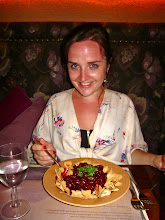
Tonight, I think we will eat at a Syrian restaurant in the marche, and then back to the books. If possible, I will write a brief update or two during the course of the next week and half, but if not -- expect a full report to be posted when I get home.
مع سلامة
Thursday, July 23, 2009

Sunday, July 19, 2009
شفشاون
Another fabulous weekend adventure! Yesterday morning, Saturday, I met up with five of my friends and we grand taxi-ed it all the way to Chefchaouen (a pretty tight ride for over four hours). On the way there, we stopped for a bit at a rest stop with a typical set up -- that is, huge sides of beef, and perhaps other tasty morsels, are hung out in the open for travelers to inspect and select, at which point your slab of choice is grilled in front of you.
Chefchaouen was one of the places that everyone in the know had recommended I see before I leave Morocco, and it certainly didn't let us down. The name literally means "look at the mountains." Indeed, the whole town, with a population of about 35,000 is located on a steep mountain in the High Atlas mountains. We spent virtually all of our time in the old medina, which is famous for being painted blue. Sure enough, almost every building, or at least the bottom half of it, is painted a pleasant periwinkle, and the doors and windows are often painted other shades. According to Lonely Planet, the blue was introduced by Jewish residents in the 1930s (accents were previously green), and perhaps for aesthetic reasons, it stuck. The medina is composed of steep, car-less cobbled alleys with few street signs (we came to know, or guess at, our way very quickly). It's a bit of a dream world: child-sized arches and soft, marshmallow-like houses are paired with bright pink flowers hung outside Aladdin-style windows. While we certainly saw other tourists, especially young backpackers, there wasn't an overwhelming amount of tourism and the residential streets of the medina were nearly empty. We had been forewarned that Chefchaouen, like much of the Rif, is the prime place for purchasing kif (similar to hashish) -- it did have a bit of a Woodstock-y feeling, quite often I caught whiffs of incense as I passed through, and there were some bizarre combinations for sale of traditionally woven blankets emblazoned with the marijuana leaf -- but the atmosphere wasn't pervasive. Chefchaouen was also quite different from the other places I've visited here so far in that the Spanish influence is quite noticeable. Everyone spoke Spanish, and as foreigners the first way we were addressed was always "Hola" insead of "Bonjour".
We arrived around mid-afternoon and went directly to lunch at a fabulous (and cheap) restaurant that appeared to be in someone's basement "Restrante Rincon Andalus". We didn't make any plans in advance, so we spent the next couple of hours exploring and also attempting to find a hotel with rooms available. We ended up staying in a pension unlisted in the guidebook, Hostal ValParadis. The cost came to $6 per person. The ground floor was the family's living room, where the teenage son (who more or less ran the business it seemed) and his little brother sat watching soccer. While we were doing paperwork, some (perhaps) friends of the family came in with a bag of fresh green figs that they shared with us. There were maybe 5 rooms total on the next two floors looking out onto an open area in the center of the building. Everything was painted eye-popping colors, and there were beautiful leather hassocks outside the rooms, but in terms of amenities, you don't get more than you pay for... the showers, one per floor, were actually just hoses on the wall of the bathroom (we didn't shower), the doors to the rooms didn't lock and neither did the tall colored-glass windows that opened onto the central open space; we also didn't get a top sheet or any blankets. But we just slept with our valuables under our pillows, and it was a fun experience.
What remained of the afternoon and evening was largely spent just meandering through the streets and eventually down to the main square, Plaza Uta el-Hammam, where there are lots of cute cafes. A little before sunset, we headed up to Ras El-Maa, a small waterfall and popular gathering place at the top of the medina just beyond the gate. Soaking our tired travelers' feet in the cool water, we were confronted with the Jebel El-Kelaa, the main mountain of Chefchaouen, right beside us. One of the things that has been very striking about Moroccan towns, and even cities like Rabat, is that every place has a definite end -- and then suddenly there is open countryside stretching as far as you can see: there is no sprawl. There was a shed where women were doing the family laundry using water from the stream and lots of shebaab lounging about on the bridge overlooking the falls. We attempted to find the nearby "ruined mosque" mentioned in the guidebook, but it became quite dark as we ascended a nearly pathless mountainside, then decided we'd better not risk arrest and headed back. It did provide us with a wonderful panoramic view of the lights of Chefchaouen at night, though.
For dinner (around 10:45), we returned to the Plaza to eat a candlelit feast on the second story of La Lampe Magique-Casa Aladdin, the mountain breeze blowing in through the open windows.
The next morning, we took it easy, grabbing some omelets at Uta el-Hammam and then exploring the restored Kasbah also on the square. Inside was a large, blossoming courtyard from which doors lead to the former castle jail, a gallery of pretty heinous contemporary artwork, and a small museum with local artifacts (traditional clothing, pottery, and musical instruments mostly). I climbed up to the tower, which was by far the best part of the Kasbah... it provided a stunning, 360 degree view of the town and the mountains (see pictures below).
Gelatos in hand, we spent our last hours in Chefchaouen doing a little shopping, meandering through the streets, getting lost in the streets, and watching a pair of goats gallop out of one of the houses before our very eyes, only to be chased back inside by a little girl. On one of the residential streets, a small boy was sitting outside with a cardboard box that he'd strapped to his body as a makeshift drum, and was practicing his beats. Throughout the town, we would peer into one of the waist-high open doors to see men with their hooded djellabas hammering away at wooden pieces, later to be painted in intricate red and yellow patterns, or bent over their tailoring.
We decided to try out the national bus system, CTM, for our return trip. After several complications, we managed to get tickets to Fez: I can't claim the bus was comfortable exactly (and of course no AC!), but there are individual seats, so we were all still in one, normally-shaped piece by the time we arrived several hours later.


Chefchaouen was one of the places that everyone in the know had recommended I see before I leave Morocco, and it certainly didn't let us down. The name literally means "look at the mountains." Indeed, the whole town, with a population of about 35,000 is located on a steep mountain in the High Atlas mountains. We spent virtually all of our time in the old medina, which is famous for being painted blue. Sure enough, almost every building, or at least the bottom half of it, is painted a pleasant periwinkle, and the doors and windows are often painted other shades. According to Lonely Planet, the blue was introduced by Jewish residents in the 1930s (accents were previously green), and perhaps for aesthetic reasons, it stuck. The medina is composed of steep, car-less cobbled alleys with few street signs (we came to know, or guess at, our way very quickly). It's a bit of a dream world: child-sized arches and soft, marshmallow-like houses are paired with bright pink flowers hung outside Aladdin-style windows. While we certainly saw other tourists, especially young backpackers, there wasn't an overwhelming amount of tourism and the residential streets of the medina were nearly empty. We had been forewarned that Chefchaouen, like much of the Rif, is the prime place for purchasing kif (similar to hashish) -- it did have a bit of a Woodstock-y feeling, quite often I caught whiffs of incense as I passed through, and there were some bizarre combinations for sale of traditionally woven blankets emblazoned with the marijuana leaf -- but the atmosphere wasn't pervasive. Chefchaouen was also quite different from the other places I've visited here so far in that the Spanish influence is quite noticeable. Everyone spoke Spanish, and as foreigners the first way we were addressed was always "Hola" insead of "Bonjour".
We arrived around mid-afternoon and went directly to lunch at a fabulous (and cheap) restaurant that appeared to be in someone's basement "Restrante Rincon Andalus". We didn't make any plans in advance, so we spent the next couple of hours exploring and also attempting to find a hotel with rooms available. We ended up staying in a pension unlisted in the guidebook, Hostal ValParadis. The cost came to $6 per person. The ground floor was the family's living room, where the teenage son (who more or less ran the business it seemed) and his little brother sat watching soccer. While we were doing paperwork, some (perhaps) friends of the family came in with a bag of fresh green figs that they shared with us. There were maybe 5 rooms total on the next two floors looking out onto an open area in the center of the building. Everything was painted eye-popping colors, and there were beautiful leather hassocks outside the rooms, but in terms of amenities, you don't get more than you pay for... the showers, one per floor, were actually just hoses on the wall of the bathroom (we didn't shower), the doors to the rooms didn't lock and neither did the tall colored-glass windows that opened onto the central open space; we also didn't get a top sheet or any blankets. But we just slept with our valuables under our pillows, and it was a fun experience.
What remained of the afternoon and evening was largely spent just meandering through the streets and eventually down to the main square, Plaza Uta el-Hammam, where there are lots of cute cafes. A little before sunset, we headed up to Ras El-Maa, a small waterfall and popular gathering place at the top of the medina just beyond the gate. Soaking our tired travelers' feet in the cool water, we were confronted with the Jebel El-Kelaa, the main mountain of Chefchaouen, right beside us. One of the things that has been very striking about Moroccan towns, and even cities like Rabat, is that every place has a definite end -- and then suddenly there is open countryside stretching as far as you can see: there is no sprawl. There was a shed where women were doing the family laundry using water from the stream and lots of shebaab lounging about on the bridge overlooking the falls. We attempted to find the nearby "ruined mosque" mentioned in the guidebook, but it became quite dark as we ascended a nearly pathless mountainside, then decided we'd better not risk arrest and headed back. It did provide us with a wonderful panoramic view of the lights of Chefchaouen at night, though.
For dinner (around 10:45), we returned to the Plaza to eat a candlelit feast on the second story of La Lampe Magique-Casa Aladdin, the mountain breeze blowing in through the open windows.
The next morning, we took it easy, grabbing some omelets at Uta el-Hammam and then exploring the restored Kasbah also on the square. Inside was a large, blossoming courtyard from which doors lead to the former castle jail, a gallery of pretty heinous contemporary artwork, and a small museum with local artifacts (traditional clothing, pottery, and musical instruments mostly). I climbed up to the tower, which was by far the best part of the Kasbah... it provided a stunning, 360 degree view of the town and the mountains (see pictures below).
Gelatos in hand, we spent our last hours in Chefchaouen doing a little shopping, meandering through the streets, getting lost in the streets, and watching a pair of goats gallop out of one of the houses before our very eyes, only to be chased back inside by a little girl. On one of the residential streets, a small boy was sitting outside with a cardboard box that he'd strapped to his body as a makeshift drum, and was practicing his beats. Throughout the town, we would peer into one of the waist-high open doors to see men with their hooded djellabas hammering away at wooden pieces, later to be painted in intricate red and yellow patterns, or bent over their tailoring.
We decided to try out the national bus system, CTM, for our return trip. After several complications, we managed to get tickets to Fez: I can't claim the bus was comfortable exactly (and of course no AC!), but there are individual seats, so we were all still in one, normally-shaped piece by the time we arrived several hours later.


Thursday, July 16, 2009
Update
There isn't too much to update you on... this week the homework has been piling on, and there are quite a few end-of-term assignments I'm trying to crank out. The Moroccan students pretty much all left campus today, since their semester ended, so for the next week it will just be Americans and participants from various conferences (and very empty!)
The last meeting of music club was yesterday, and we learned a new song, this one in darija, called علاش يا غزالي, or "Why, My Gazelle". Here's the link to the youtube video of it so you can get an idea of what we've been singing. (The video for Shemsu Lachia is not great, so I didn't post it.) http://www.youtube.com/watch?v=DpYXCEfPqVo
Then, today, the school put on a mock Moroccan wedding with students from the ARANAS program. A traditional velvet tent was erected with an over-the-top silk and gold throne for the bride and groom inside, and plenty of tasty treats. The bride (or brides, actually, since there were two) was brought out sitting cross-legged in a golden sedan chair carried by four men in matching red suits. The groom stood in front and did a little dance. A band had been hired to blow the wedding horns and play the drums, and they danced around wildly while the couple were led in. On hand as well were a henna artist to decorate the wedding party, a special party planner in a rhinestoned Yves St Laurent djellaba, and miscellaneous women who were capable of making the wedding ululations. The actual ceremony consisted of a some dancing and a lot of sitting on the throne while people took pictures with the bride and groom (unfortunately, I didn't have my camera!) They were decked out in full traditional attire (but changed their dresses only once, not 6 or 7 times as is the usual practice), with golden crowns, decadent jewelry, and sparkly, colorful dresses with lots of jewels and sequins.
The last meeting of music club was yesterday, and we learned a new song, this one in darija, called علاش يا غزالي, or "Why, My Gazelle". Here's the link to the youtube video of it so you can get an idea of what we've been singing. (The video for Shemsu Lachia is not great, so I didn't post it.) http://www.youtube.com/watch?v=DpYXCEfPqVo
Then, today, the school put on a mock Moroccan wedding with students from the ARANAS program. A traditional velvet tent was erected with an over-the-top silk and gold throne for the bride and groom inside, and plenty of tasty treats. The bride (or brides, actually, since there were two) was brought out sitting cross-legged in a golden sedan chair carried by four men in matching red suits. The groom stood in front and did a little dance. A band had been hired to blow the wedding horns and play the drums, and they danced around wildly while the couple were led in. On hand as well were a henna artist to decorate the wedding party, a special party planner in a rhinestoned Yves St Laurent djellaba, and miscellaneous women who were capable of making the wedding ululations. The actual ceremony consisted of a some dancing and a lot of sitting on the throne while people took pictures with the bride and groom (unfortunately, I didn't have my camera!) They were decked out in full traditional attire (but changed their dresses only once, not 6 or 7 times as is the usual practice), with golden crowns, decadent jewelry, and sparkly, colorful dresses with lots of jewels and sequins.
Sunday, July 12, 2009
Weekend Adventures
This weekend, the whole program went to Marrakech, but those of us in Contemporary Issues were not allowed (since we'd already been). We were unable to put together or afford an elaborate trip, so I've spent a more or less relaxed 3-day weekend on and near campus.
After a lazy Friday morning, I went with Erin and Dave to Ain Vittel, a waterfall and picnic ground about a 15-minute taxi ride from campus. It seemed a popular place for Moroccans to come with their kids and spend a summer afternoon -- it was fairly crowded. There were several little boys with horses, and I negotiated with them a one-hour ride through the fields and up around the falls. Unfortunately, once we were already trotting off, the boys' older brother came and insisted they had told us the wrong price (in other words, the little boy had told us the real Moroccan price, while the older guy was giving us the tourist price.) They pegged me from the beginning as the one who sort of spoke Arabic, and so I was harassed constantly for the whole trip... yet, unfortunately, my language skills were not sufficient to explain to them what I actually wanted to say. It was a beautiful ride, though, and the leafy shade of the park was a welcome repose from the boiling heat of the afternoon. When we were finished, I was approached by a toothy honey salesman who was eager to practice French for some reason, and insisted that I not speak Arabic to him. After I insisted that I had no money to buy, he extracted an enormous tub of honey and let me stick my thumb in for a taste. It was cedar honey, he said, and probably some of the best I've ever tasted.
Later Friday night, I headed out with some friends to the marche to buy a movie to watch. Overnight, Ifrane has swelled to perhaps hundreds of times its normal size -- it is finally vacation time in Morocco, and everyone who can afford it is in Ifrane. There is a little green and white "train" that ferries families around town, there are flashing Christmas lights in the trees, and the crowd around the great stone lion has ballooned. We bought two pirated DVDs (that's all there is) from a little shop at the marche, and ended up in a long conversation with the grinning old proprietor comparing fusHa to darija to various other colloquial dialects. As it turned out, the movies, both American, were dubbed in French and I also think gave my computer a virus.
Twelve hours later, I was squished into the back seat of a grand taxi bound for Fez. Trying to entice sleep, I gave up and cracked an eyelid when John Lennon's "Imagine" came onto the radio... in Arabic. It's hard to believe that walking through the winding alleys of Fez's old medina is no longer a culture shock. Sometimes, I begin to forget how different this place is from home. Then a donkey trudging along beneath crates of coke bottles will suddenly round the corner or I'll hear the call to prayer echoing across the souk -- or, as in the old medina, where there is huge number of mosques within a tiny area, a pulsing blanket of voices chanting "Allahu Akbar" almost in unison.
We spent most of the day walking around the old medina shopping, since my friends had a lot of gifts to buy. Our Moroccan friend Sara (the one whose birthday party we threw) came with us. We thought we'd encounter less harassment when accompanied by a Moroccan, but in fact this was the first time that we were relentlessly pursued (for nearly an hour) by two would-be "faux guides". Sara offered to go into the shrine to Moulay Idriss II and take photos for us, since it is not permitted to non-Muslims -- seeing the pictures made me really regret that we weren't allowed in! We ate lunch at Palace Tariana, the same place we'd been with Dr. Shoup, and afterward met up with my friend Ada Petiwala, a friend of Diana's from Bard and a fellow staffer from Model UN this spring. Since Ada's been living in the old medina for the past 6 weeks studying in another Arabic program, she knew her way around well and led us to some reliable shops.
Completely by accident, we stumbled upon the antique store of Sidi Mohammed, the friend of Dr. Shoup's who had made us tea and cookies in his living museum of a home on our last visit. He recognized us the moment we walked in the door and greeted us with warm kisses and cold water. Bringing us upstairs, he brought out some of his newest treasures, including a miniature Qur'an in a velvet case from the 17th century. (Of course he didn't expect us to buy it for several thousand dollars, and in fact explained that it would probably go to a wealthy Saudi collector.) He insisted that we come by again before we leave the country.
Some typical views of the old medina:

Sunday has been a sick day, but these things are to be expected. Hopefully better tomorrow!
After a lazy Friday morning, I went with Erin and Dave to Ain Vittel, a waterfall and picnic ground about a 15-minute taxi ride from campus. It seemed a popular place for Moroccans to come with their kids and spend a summer afternoon -- it was fairly crowded. There were several little boys with horses, and I negotiated with them a one-hour ride through the fields and up around the falls. Unfortunately, once we were already trotting off, the boys' older brother came and insisted they had told us the wrong price (in other words, the little boy had told us the real Moroccan price, while the older guy was giving us the tourist price.) They pegged me from the beginning as the one who sort of spoke Arabic, and so I was harassed constantly for the whole trip... yet, unfortunately, my language skills were not sufficient to explain to them what I actually wanted to say. It was a beautiful ride, though, and the leafy shade of the park was a welcome repose from the boiling heat of the afternoon. When we were finished, I was approached by a toothy honey salesman who was eager to practice French for some reason, and insisted that I not speak Arabic to him. After I insisted that I had no money to buy, he extracted an enormous tub of honey and let me stick my thumb in for a taste. It was cedar honey, he said, and probably some of the best I've ever tasted.
Later Friday night, I headed out with some friends to the marche to buy a movie to watch. Overnight, Ifrane has swelled to perhaps hundreds of times its normal size -- it is finally vacation time in Morocco, and everyone who can afford it is in Ifrane. There is a little green and white "train" that ferries families around town, there are flashing Christmas lights in the trees, and the crowd around the great stone lion has ballooned. We bought two pirated DVDs (that's all there is) from a little shop at the marche, and ended up in a long conversation with the grinning old proprietor comparing fusHa to darija to various other colloquial dialects. As it turned out, the movies, both American, were dubbed in French and I also think gave my computer a virus.
Twelve hours later, I was squished into the back seat of a grand taxi bound for Fez. Trying to entice sleep, I gave up and cracked an eyelid when John Lennon's "Imagine" came onto the radio... in Arabic. It's hard to believe that walking through the winding alleys of Fez's old medina is no longer a culture shock. Sometimes, I begin to forget how different this place is from home. Then a donkey trudging along beneath crates of coke bottles will suddenly round the corner or I'll hear the call to prayer echoing across the souk -- or, as in the old medina, where there is huge number of mosques within a tiny area, a pulsing blanket of voices chanting "Allahu Akbar" almost in unison.
We spent most of the day walking around the old medina shopping, since my friends had a lot of gifts to buy. Our Moroccan friend Sara (the one whose birthday party we threw) came with us. We thought we'd encounter less harassment when accompanied by a Moroccan, but in fact this was the first time that we were relentlessly pursued (for nearly an hour) by two would-be "faux guides". Sara offered to go into the shrine to Moulay Idriss II and take photos for us, since it is not permitted to non-Muslims -- seeing the pictures made me really regret that we weren't allowed in! We ate lunch at Palace Tariana, the same place we'd been with Dr. Shoup, and afterward met up with my friend Ada Petiwala, a friend of Diana's from Bard and a fellow staffer from Model UN this spring. Since Ada's been living in the old medina for the past 6 weeks studying in another Arabic program, she knew her way around well and led us to some reliable shops.
Completely by accident, we stumbled upon the antique store of Sidi Mohammed, the friend of Dr. Shoup's who had made us tea and cookies in his living museum of a home on our last visit. He recognized us the moment we walked in the door and greeted us with warm kisses and cold water. Bringing us upstairs, he brought out some of his newest treasures, including a miniature Qur'an in a velvet case from the 17th century. (Of course he didn't expect us to buy it for several thousand dollars, and in fact explained that it would probably go to a wealthy Saudi collector.) He insisted that we come by again before we leave the country.
Some typical views of the old medina:

Sunday has been a sick day, but these things are to be expected. Hopefully better tomorrow!
Friday, July 10, 2009
هذا الاسبوع (This Week)
For the most part, this week was pretty normal, with a few interesting experiences (which I will highlight).
On Tuesday, I was studying in the library when a girl from the student activities council came up and begged me to be in the AUI welcome video that will be shown to new students in the fall. There ended up being about 10 of us Americans, plus several Moroccans participating. We filmed in two locations, had to lounge casually and move our hands to "look natural" and say in unison "مرحبا بكم في جامعة الاخوين", "Welcome to AUI", and "Enjoy your time at AUI."
The next day, Sebastien, Osahon, and I went for dinner again at Pizza Diafa at the marche (I don't think they actually serve pizza, so it's a bit of a misnomer), since we hadn't been in a few weeks. When we returned, the "traditional music" concert was just getting underway in front of the mat'am. The school had hired several different lively groups, mostly in white djellabas and wielding drums and long horns -- however, there was also a Gnaoua group with the telltale metal castanets. Many students, including Moroccans, came out for the occasion, and while I left at 11, I heard the concert was still going strong at 2am.
Then, on Thursday, I found out at the last minute that the Rev. Karen Smith, a really friendly American who has been at AUI for 13 years and coordinates the Christian community on campus, was driving a few people to the squatter village of Tarmilat. So I decided to come along. Tarmilat is only about an 8 minute drive from Ifrane, but is a completely different kind of place. The village consists of several low huts of stone, plastic tarps, and tin cans built onto a barren hillside. I couldn't tell how large the community was -- not more than a couple hundred, possibly much smaller, and it seemed to be made up of both Arabs and Berbers. Since the residents are just squatters, they are not allowed to build any permanent structures: although, at Rev. Smith's urging, the government recently built a one-room schoolhouse nearby so that some of the children could begin attending school. The men of village are shepherds, but the women, working with students from AUI's high school (in fact, my roommate's sister was the founder of the program!) have developed their weaving, a skill that was going unused until very recently, into a business. They now make beautiful rugs, bags, and pillowcases, although I think they are quite dependent on AUI (and especially Karen Smith) to distribute them -- I don't see how anyone would be able to stumble upon the village (or possibly even find it with directions, since the road wasn't marked). One of the first things that the more successful weavers are starting to buy are solar panels, so there is now some limited electricity available. For each item sold, the proceeds go directly to the woman who made it. And AUI has helped them make cards in English with each woman's story, but getting to meet them ourselves made our purchases that much more meaningful. Here is the story of Zohra Amawi:
"Zohra Amawi is in her thirties. She was born and raised near Sefrou before marrying and moving to Tarmilat. Because she can't afford the 20dh [about $2.50] for the taxi, she sees her family only once a year. She has 4 daughters and a son. The three oldest girls go to high school in Ifrane; the youngest daughter will start at Tarmilat school in 2008. Her eldest daughter, Hanane, wants to work in the military. In 2008, Zohra found out she has diabetes. Her only dream is to see her children have a better life."
Even with the occasional medical care that the villagers are able to receive as a result of the weaving income, tragedies are not uncommon. When we arrived, more than a dozen women were gathered at the home of an 18-year-old boy who had died two days earlier after falling off a nearby barrage and drowning. Even the youngest women look far older than they are.
As we were looking at the rugs, several large cows walked out of the shed, followed by a bunch of chickens. They just go free... one calf actually followed a bunch of toddlers into the hut where they do the weaving and began urinating next to the loom. The children at Tarmilat were great -- except for one dangerous little tot who ran around with a vicious grin hitting everyone in her path with a big metal pipe that she had picked up off the ground!
After seeing all the rugs, we were invited into the home of the deceased boy for a meal. We took off our shoes at the entrance and sat, along with women and children (no men were in sight) on carpets around the perimeter of the hut. Rev. Smith told them we had no time for food, but within 5 minutes we were brought a steaming beef tajine and heaps of bread. As is customary, although a little awkward at first, we as guests ate alone while everyone else watched. Next, we were brought a heaping platter of couscous, which would normally be eaten only on Fridays, but was made for the funeral of the boy. Finally, we had a round of tea (of course!). Before we left, we had another round of kisses with each of the women, from 5 to perhaps 85, sitting in the hut, and they sent us off with the remainder of the couscous.
Our Contemporary Issues lecture, given by an Armenian professor who grew up in Sudan, centered on Islamist terrorist groups inside Morocco. We were a little worried that, as had happened during Prof. Kalpakian's previous lecture, the Q&A might descend into mudslinging between the professor and Fabio, an Algerian student from the Diplomatic Academy of London (an institution for which Dr. Shoup has no respect at all) who paradoxically supports the far right Le Pen in France. Fortunately it did not, and the lecture was extremely interesting. One of his main points was that poverty is not really a factor in driving individuals to join terrorist groups in Morocco -- that in fact, most recruits tend to be reasonably successful small businessmen, juice vendors in the medinas, salesclerks, etc.
Last night, many of us were invited to a party that some of Osahon's friends, 3 African French guys who are regular students at AUI but don't like it too much, were throwing at a rented vacation home in Ifrane. I was a little apprehensive because of what I'd heard about these wild "apartment parties", but I was with a large number of Americans and in fact the party turned out to be very laid-back. The decor of the apartment was probably the most interesting thing: there was a traditional Moroccan living room with long couches, but the ceiling was cork, there was a creepy sepia portrait of a random woman on the mantle, and in the basement was a bizarre tapestry of white-tailed deer like something you'd probably find in an American hunting lodge.
On Tuesday, I was studying in the library when a girl from the student activities council came up and begged me to be in the AUI welcome video that will be shown to new students in the fall. There ended up being about 10 of us Americans, plus several Moroccans participating. We filmed in two locations, had to lounge casually and move our hands to "look natural" and say in unison "مرحبا بكم في جامعة الاخوين", "Welcome to AUI", and "Enjoy your time at AUI."
The next day, Sebastien, Osahon, and I went for dinner again at Pizza Diafa at the marche (I don't think they actually serve pizza, so it's a bit of a misnomer), since we hadn't been in a few weeks. When we returned, the "traditional music" concert was just getting underway in front of the mat'am. The school had hired several different lively groups, mostly in white djellabas and wielding drums and long horns -- however, there was also a Gnaoua group with the telltale metal castanets. Many students, including Moroccans, came out for the occasion, and while I left at 11, I heard the concert was still going strong at 2am.
Then, on Thursday, I found out at the last minute that the Rev. Karen Smith, a really friendly American who has been at AUI for 13 years and coordinates the Christian community on campus, was driving a few people to the squatter village of Tarmilat. So I decided to come along. Tarmilat is only about an 8 minute drive from Ifrane, but is a completely different kind of place. The village consists of several low huts of stone, plastic tarps, and tin cans built onto a barren hillside. I couldn't tell how large the community was -- not more than a couple hundred, possibly much smaller, and it seemed to be made up of both Arabs and Berbers. Since the residents are just squatters, they are not allowed to build any permanent structures: although, at Rev. Smith's urging, the government recently built a one-room schoolhouse nearby so that some of the children could begin attending school. The men of village are shepherds, but the women, working with students from AUI's high school (in fact, my roommate's sister was the founder of the program!) have developed their weaving, a skill that was going unused until very recently, into a business. They now make beautiful rugs, bags, and pillowcases, although I think they are quite dependent on AUI (and especially Karen Smith) to distribute them -- I don't see how anyone would be able to stumble upon the village (or possibly even find it with directions, since the road wasn't marked). One of the first things that the more successful weavers are starting to buy are solar panels, so there is now some limited electricity available. For each item sold, the proceeds go directly to the woman who made it. And AUI has helped them make cards in English with each woman's story, but getting to meet them ourselves made our purchases that much more meaningful. Here is the story of Zohra Amawi:
"Zohra Amawi is in her thirties. She was born and raised near Sefrou before marrying and moving to Tarmilat. Because she can't afford the 20dh [about $2.50] for the taxi, she sees her family only once a year. She has 4 daughters and a son. The three oldest girls go to high school in Ifrane; the youngest daughter will start at Tarmilat school in 2008. Her eldest daughter, Hanane, wants to work in the military. In 2008, Zohra found out she has diabetes. Her only dream is to see her children have a better life."
Even with the occasional medical care that the villagers are able to receive as a result of the weaving income, tragedies are not uncommon. When we arrived, more than a dozen women were gathered at the home of an 18-year-old boy who had died two days earlier after falling off a nearby barrage and drowning. Even the youngest women look far older than they are.
As we were looking at the rugs, several large cows walked out of the shed, followed by a bunch of chickens. They just go free... one calf actually followed a bunch of toddlers into the hut where they do the weaving and began urinating next to the loom. The children at Tarmilat were great -- except for one dangerous little tot who ran around with a vicious grin hitting everyone in her path with a big metal pipe that she had picked up off the ground!
After seeing all the rugs, we were invited into the home of the deceased boy for a meal. We took off our shoes at the entrance and sat, along with women and children (no men were in sight) on carpets around the perimeter of the hut. Rev. Smith told them we had no time for food, but within 5 minutes we were brought a steaming beef tajine and heaps of bread. As is customary, although a little awkward at first, we as guests ate alone while everyone else watched. Next, we were brought a heaping platter of couscous, which would normally be eaten only on Fridays, but was made for the funeral of the boy. Finally, we had a round of tea (of course!). Before we left, we had another round of kisses with each of the women, from 5 to perhaps 85, sitting in the hut, and they sent us off with the remainder of the couscous.
Our Contemporary Issues lecture, given by an Armenian professor who grew up in Sudan, centered on Islamist terrorist groups inside Morocco. We were a little worried that, as had happened during Prof. Kalpakian's previous lecture, the Q&A might descend into mudslinging between the professor and Fabio, an Algerian student from the Diplomatic Academy of London (an institution for which Dr. Shoup has no respect at all) who paradoxically supports the far right Le Pen in France. Fortunately it did not, and the lecture was extremely interesting. One of his main points was that poverty is not really a factor in driving individuals to join terrorist groups in Morocco -- that in fact, most recruits tend to be reasonably successful small businessmen, juice vendors in the medinas, salesclerks, etc.
Last night, many of us were invited to a party that some of Osahon's friends, 3 African French guys who are regular students at AUI but don't like it too much, were throwing at a rented vacation home in Ifrane. I was a little apprehensive because of what I'd heard about these wild "apartment parties", but I was with a large number of Americans and in fact the party turned out to be very laid-back. The decor of the apartment was probably the most interesting thing: there was a traditional Moroccan living room with long couches, but the ceiling was cork, there was a creepy sepia portrait of a random woman on the mantle, and in the basement was a bizarre tapestry of white-tailed deer like something you'd probably find in an American hunting lodge.
Sunday, July 5, 2009
الرباط
This was the first weekend that there were no planned trips for Contemporary Issues, so nine of us decided to spend it in the capital, Rabat. We set off around 7:30am Saturday morning from the grand taxi stand at the marche. The grand taxis are boxy, puce-colored old Mercedes that travel between cities. They "fit" six passengers, 4 in the back and 2 (plus the driver) in the front -- it's a pretty tight ride to say the least! (In contrast, the petit taxis travel within city limits and will take only 3 passengers). We were fortunately able to find seats on the train from Meknes and had the sort of bizarre prolonged musical accompaniment of the cell phone of the heavily hair gelled man next to us playing "Umbrella" by Rihanna.
Our hotel in Rabat, recommended by Dr. Shoup, cost each of us 240 dirhams for the night... that's only $30. But it had a fantastic location on the palm-lined Mohamed V Boulevard, across the street from the Moroccan Parliament. There was a large terrace cafe out front, and one of many booksellers with his wares spread out on the sidewalk. We all immediately liked Rabat: it is definitely less exotic than some of the other cities we've visited, but it is very clean, friendly, and pretty, and there is a perpetual light breeze coming off the ocean. Our first stop was the U.S. Embassy's 4th of July party, held at the American School of Rabat. Believe it or not, the hamburgers and real hot dogs with ketchup were actually delicious (no salads, though!) after the AUI "mat'am" food. We played frisbee with expats and lounged in the sun for a bit, though we did not get to meet the ambassador and I'm pretty sure Ben & Jerry were not in attendance.
After the party, we headed out to the Tour Hassan, the minaret of a mosque half-built by 12th century Sultan Yacoub el-Mansour. The mosque was intended to be enormous, but what remains of his building project is a large plaza of low columns, and the incomplete minaret. It seemed to be a popular spot for families and couples to come for an evening stroll, as well as a certain brand of aggressive henna artist (they come up to girls and quickly begin squirting henna onto their arms, then demand money... although we ran into one of them later in town and she was extremely friendly.) The plaza overlooks a lush park, and beyond, the ocean. At one end is the gold-laden mausoleum of Moulay Abdullah, Mohamed V, and Hassan II, the last three kings of Morocco. Abdullah, the father of the other two, lies in a dramatic marble tomb in the center of the chamber, his sons in two of the corners; visitors look down onto them from a second-floor gallery.
This picture was taken with the guards outside the mausoleum.

We then meandered along the boardwalk, where again people were out for a leisurely evening promenade. The water was littered with little blue and red rowboats, mostly ferrying people across to the city of Sale.
We made our way up a hill to the old medina, and walked for a bit through the souk, which was practically spotless and had much broader lanes than in the other cities we've visited. Then we ascended into the kasbah neighborhood, where all the buildings are painted white and brilliant blue, and most houses have window boxes of eye-popping fuchsia or yellow flowers. Since the kasbah is on a hill, we eventually reached the top, where there was a large open area that looked out over the ocean. We arrived just before sunset. The whitewashed buildings behind us and the surfers in the water below took on a deep pink glow as the lights of the city appeared and the sun dropped below the horizon.


When the last light was gone, we wandered along the beach for a bit. We suddenly realized that beside us was a vast hillside necropolis, tombstones pointing every which way -- an eerie sight in the moonlight. Finding no affordable restaurant near the water, we ended up eating around 11pm in a classy restaurant called Le Petit Beur-Dar Tajine near our hotel -- there was even an 'oud player who agreed to play "Shemsu al-Ashi" from music club for us.
After dinner, we met up with some other ARANAS students staying at a nearby hotel and tried to find some sort of nightlife, but it was not to be found in our part of the city (plus, even with a large group, we were being persistently harassed), so we called it a night. The next morning, I went with my friend Grace to a very French patisserie for breakfast, and then we headed out as a group to Chellah, a fascinating site just outside the city walls.
Chellah was the first settlement in the Rabat area, at the mouth of the Bou Regreg river, and was likely originally Phoenician. The first layer of ruins visible today dates from the Roman era. The Romans appropriated the settlement in 40AD and named it Sala Colonia. There are no signs, so the buildings' intended purposes are left to the imagination, but there is a row of what appear to have been shops, overturned columns and statues, and what is supposed to have been the forum. Sala Colonia was abandoned by the Romans in 250AD, but in the 14th century, the Marinid Sultan Abu al-Hasan built again atop the old city. He added a mosque, zawiya, and several tombs... but this Islamic layer was destroyed in the great earthquake of 1755, and the site was abandoned. Today it is in a state of arrested decay, the crumbling minaret of Abu al-Hasan's mosque towering above the Roman columns, slabs of Roman marble interspersed with the zellij (tiled) pool of what was once the zawiya. Everything is overgrown with dazzling blooms and tangled vines. A little orange kitten, hardly bigger than my hand, trotted behind us throughout the ruins. I discovered a fluffy baby stork toddling around the decaying mihrab of the zawiya. Indeed, it was silent but for the clapping beaks of the perhaps thousands of storks nesting atop the minaret and in every tree on the hillside behind us.


After lunch at "Nice & Quick", we split and I went with my friend Corinne in search of the bus that would inshallah bring us to the beach. After some difficulty, we tracked down the #33, which looked as if it could fall apart worrisomely soon, at a massive roundabout in the heart of the city. Since we got on at the beginning of the route, we had seats... but soon there were several layers of people sitting in the aisles and hanging out the door... this posed a serious problem when we attempted to get off (especially since i had made the poor decision of wearing a skirt). In fact, we couldn't get off, and had to make a huge scene that involved numerous people hissing and clapping at the driver. We had asked around for the best beach, and ended up at Temara, about 15km or so outside the city of Rabat. It was clearly a favorite spot of Moroccan vacationers, and the sand, while not pristine, was papered with brightly colored umbrellas. There was an amusement park and a few camels to ride if you so desired, and a large outcropping of volcanic rock where men were fishing.
We walked a ways to a less populous strip of sand with whitewashed beach houses then suddenly realized that we had to leave pronto if we wanted to catch the train home. Unfortunately, the bus wouldn't have gotten us back in time even if we could track it down (iffy). So we opted for the taxi route, harassed by numerous sleazy 12-year-olds along the way to the main road. After driving for a few minutes, the driver pulled over on the side of the road, removed his taxi sign from the roof of his car, mumbled something about the police, and told my friend to get in the front seat. This was cause for alarm. I was sure he was going to take us to his uncle's rug shop, or much worse. I tried to get out of the car, but he pulled away... meanwhile, all the "Rabat" signs were pointing in the opposite direction. To make a long story short, we eventually made it to the train station with 5 minutes to spare. The beach had been in a different city and he was taking us illegally -- he also, we realized, did not know his way around Rabat, and could not read the map we gave him, nor could he understand French, which was what we had been speaking to him since our Arabic was insufficient. But in the end, all was okay, we lived, and we arrived home safely by 8pm.
Our hotel in Rabat, recommended by Dr. Shoup, cost each of us 240 dirhams for the night... that's only $30. But it had a fantastic location on the palm-lined Mohamed V Boulevard, across the street from the Moroccan Parliament. There was a large terrace cafe out front, and one of many booksellers with his wares spread out on the sidewalk. We all immediately liked Rabat: it is definitely less exotic than some of the other cities we've visited, but it is very clean, friendly, and pretty, and there is a perpetual light breeze coming off the ocean. Our first stop was the U.S. Embassy's 4th of July party, held at the American School of Rabat. Believe it or not, the hamburgers and real hot dogs with ketchup were actually delicious (no salads, though!) after the AUI "mat'am" food. We played frisbee with expats and lounged in the sun for a bit, though we did not get to meet the ambassador and I'm pretty sure Ben & Jerry were not in attendance.
After the party, we headed out to the Tour Hassan, the minaret of a mosque half-built by 12th century Sultan Yacoub el-Mansour. The mosque was intended to be enormous, but what remains of his building project is a large plaza of low columns, and the incomplete minaret. It seemed to be a popular spot for families and couples to come for an evening stroll, as well as a certain brand of aggressive henna artist (they come up to girls and quickly begin squirting henna onto their arms, then demand money... although we ran into one of them later in town and she was extremely friendly.) The plaza overlooks a lush park, and beyond, the ocean. At one end is the gold-laden mausoleum of Moulay Abdullah, Mohamed V, and Hassan II, the last three kings of Morocco. Abdullah, the father of the other two, lies in a dramatic marble tomb in the center of the chamber, his sons in two of the corners; visitors look down onto them from a second-floor gallery.
This picture was taken with the guards outside the mausoleum.

We then meandered along the boardwalk, where again people were out for a leisurely evening promenade. The water was littered with little blue and red rowboats, mostly ferrying people across to the city of Sale.
We made our way up a hill to the old medina, and walked for a bit through the souk, which was practically spotless and had much broader lanes than in the other cities we've visited. Then we ascended into the kasbah neighborhood, where all the buildings are painted white and brilliant blue, and most houses have window boxes of eye-popping fuchsia or yellow flowers. Since the kasbah is on a hill, we eventually reached the top, where there was a large open area that looked out over the ocean. We arrived just before sunset. The whitewashed buildings behind us and the surfers in the water below took on a deep pink glow as the lights of the city appeared and the sun dropped below the horizon.


When the last light was gone, we wandered along the beach for a bit. We suddenly realized that beside us was a vast hillside necropolis, tombstones pointing every which way -- an eerie sight in the moonlight. Finding no affordable restaurant near the water, we ended up eating around 11pm in a classy restaurant called Le Petit Beur-Dar Tajine near our hotel -- there was even an 'oud player who agreed to play "Shemsu al-Ashi" from music club for us.
After dinner, we met up with some other ARANAS students staying at a nearby hotel and tried to find some sort of nightlife, but it was not to be found in our part of the city (plus, even with a large group, we were being persistently harassed), so we called it a night. The next morning, I went with my friend Grace to a very French patisserie for breakfast, and then we headed out as a group to Chellah, a fascinating site just outside the city walls.
Chellah was the first settlement in the Rabat area, at the mouth of the Bou Regreg river, and was likely originally Phoenician. The first layer of ruins visible today dates from the Roman era. The Romans appropriated the settlement in 40AD and named it Sala Colonia. There are no signs, so the buildings' intended purposes are left to the imagination, but there is a row of what appear to have been shops, overturned columns and statues, and what is supposed to have been the forum. Sala Colonia was abandoned by the Romans in 250AD, but in the 14th century, the Marinid Sultan Abu al-Hasan built again atop the old city. He added a mosque, zawiya, and several tombs... but this Islamic layer was destroyed in the great earthquake of 1755, and the site was abandoned. Today it is in a state of arrested decay, the crumbling minaret of Abu al-Hasan's mosque towering above the Roman columns, slabs of Roman marble interspersed with the zellij (tiled) pool of what was once the zawiya. Everything is overgrown with dazzling blooms and tangled vines. A little orange kitten, hardly bigger than my hand, trotted behind us throughout the ruins. I discovered a fluffy baby stork toddling around the decaying mihrab of the zawiya. Indeed, it was silent but for the clapping beaks of the perhaps thousands of storks nesting atop the minaret and in every tree on the hillside behind us.


After lunch at "Nice & Quick", we split and I went with my friend Corinne in search of the bus that would inshallah bring us to the beach. After some difficulty, we tracked down the #33, which looked as if it could fall apart worrisomely soon, at a massive roundabout in the heart of the city. Since we got on at the beginning of the route, we had seats... but soon there were several layers of people sitting in the aisles and hanging out the door... this posed a serious problem when we attempted to get off (especially since i had made the poor decision of wearing a skirt). In fact, we couldn't get off, and had to make a huge scene that involved numerous people hissing and clapping at the driver. We had asked around for the best beach, and ended up at Temara, about 15km or so outside the city of Rabat. It was clearly a favorite spot of Moroccan vacationers, and the sand, while not pristine, was papered with brightly colored umbrellas. There was an amusement park and a few camels to ride if you so desired, and a large outcropping of volcanic rock where men were fishing.
We walked a ways to a less populous strip of sand with whitewashed beach houses then suddenly realized that we had to leave pronto if we wanted to catch the train home. Unfortunately, the bus wouldn't have gotten us back in time even if we could track it down (iffy). So we opted for the taxi route, harassed by numerous sleazy 12-year-olds along the way to the main road. After driving for a few minutes, the driver pulled over on the side of the road, removed his taxi sign from the roof of his car, mumbled something about the police, and told my friend to get in the front seat. This was cause for alarm. I was sure he was going to take us to his uncle's rug shop, or much worse. I tried to get out of the car, but he pulled away... meanwhile, all the "Rabat" signs were pointing in the opposite direction. To make a long story short, we eventually made it to the train station with 5 minutes to spare. The beach had been in a different city and he was taking us illegally -- he also, we realized, did not know his way around Rabat, and could not read the map we gave him, nor could he understand French, which was what we had been speaking to him since our Arabic was insufficient. But in the end, all was okay, we lived, and we arrived home safely by 8pm.
Thursday, July 2, 2009
A Moroccan Barbecue and a Birthday Party
Yesterday, Wednesday, we had clubs from 10am-noon as usual. I'd heard good things about the music club, so I decided to try it out. There were about ten students and a very serious but very talented teacher who played the oud. He wrote out the words to a well-known Moroccan folk song called "شمس العشي". The teacher had us recite the words many times over, beating out the rhythm on our shoulders. Then we sang, with and without his skillful oud accompaniment. Besides the vocabulary, which was very poetic, the hardest thing for me was imitating the vocal gyration that distinguishes Arabic music but usually sounds kind of ridiculous when we try it. But I think music club has been my favorite so far -- the oud is a beautiful instrument and the song we learned was really catchy.
In the afternoon, a few of us went to the marche to buy a box of cookies for our Moroccan friend Sara, whose 22nd birthday is today. Originally we had intended to get her a DVD, although all that is available here are pirated copies of largely unknown American films (costing approximately $1.25)... however, Osahon did manage to find such a copy of Charlie Chaplin's "The Great Dictator" from a makeup/used children's toys store.
In the evening, the ARANAS program put on a "4th of July Barbecue" with chicken and beef kebabs, rice, and cooked vegetables out by one of the soccer fields during the weekly soccer tournament between ARANAS students, professors, and regular Al-Akhawayn students. This time there was also a band of traditional Moroccan instruments (tambourines, drums, the long wedding horns) and a henna artist (see below).

Later at night, the school sponsored a DJ party outside the cafeteria, and a number of the Arabic professors were present. The whole social dynamic on campus here is very different from the U.S., given that students aren't allowed in the dorm buildings of the opposite gender, the library isn't open late, there isn't much to do in town (and it's a 15 minute walk anyway), and of course there is no alcohol on campus. Students who want to party, and there are plenty of them, rent apartments in Ifrane so that they will not have to come back for curfew (midnight on weeknights) or be interrogated by the guards who monitor the one entrance to campus. There also aren't many gathering places on campus, so if people want to hang out, they usually sit out in front of the cafeteria, in the cafe/game room that opens onto the same court, or the adjacent student activities room. I wasn't at the dance party too long, though, because we were throwing an impromptu birthday party for Sara. We shared the cookies around with everyone who showed up, and Sara supplied sodas and chips.

In the afternoon, a few of us went to the marche to buy a box of cookies for our Moroccan friend Sara, whose 22nd birthday is today. Originally we had intended to get her a DVD, although all that is available here are pirated copies of largely unknown American films (costing approximately $1.25)... however, Osahon did manage to find such a copy of Charlie Chaplin's "The Great Dictator" from a makeup/used children's toys store.
In the evening, the ARANAS program put on a "4th of July Barbecue" with chicken and beef kebabs, rice, and cooked vegetables out by one of the soccer fields during the weekly soccer tournament between ARANAS students, professors, and regular Al-Akhawayn students. This time there was also a band of traditional Moroccan instruments (tambourines, drums, the long wedding horns) and a henna artist (see below).

Later at night, the school sponsored a DJ party outside the cafeteria, and a number of the Arabic professors were present. The whole social dynamic on campus here is very different from the U.S., given that students aren't allowed in the dorm buildings of the opposite gender, the library isn't open late, there isn't much to do in town (and it's a 15 minute walk anyway), and of course there is no alcohol on campus. Students who want to party, and there are plenty of them, rent apartments in Ifrane so that they will not have to come back for curfew (midnight on weeknights) or be interrogated by the guards who monitor the one entrance to campus. There also aren't many gathering places on campus, so if people want to hang out, they usually sit out in front of the cafeteria, in the cafe/game room that opens onto the same court, or the adjacent student activities room. I wasn't at the dance party too long, though, because we were throwing an impromptu birthday party for Sara. We shared the cookies around with everyone who showed up, and Sara supplied sodas and chips.

Subscribe to:
Posts (Atom)