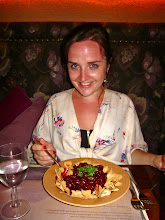
Our hotel in Rabat, recommended by Dr. Shoup, cost each of us 240 dirhams for the night... that's only $30. But it had a fantastic location on the palm-lined Mohamed V Boulevard, across the street from the Moroccan Parliament. There was a large terrace cafe out front, and one of many booksellers with his wares spread out on the sidewalk. We all immediately liked Rabat: it is definitely less exotic than some of the other cities we've visited, but it is very clean, friendly, and pretty, and there is a perpetual light breeze coming off the ocean. Our first stop was the U.S. Embassy's 4th of July party, held at the American School of Rabat. Believe it or not, the hamburgers and real hot dogs with ketchup were actually delicious (no salads, though!) after the AUI "mat'am" food. We played frisbee with expats and lounged in the sun for a bit, though we did not get to meet the ambassador and I'm pretty sure Ben & Jerry were not in attendance.
After the party, we headed out to the Tour Hassan, the minaret of a mosque half-built by 12th century Sultan Yacoub el-Mansour. The mosque was intended to be enormous, but what remains of his building project is a large plaza of low columns, and the incomplete minaret. It seemed to be a popular spot for families and couples to come for an evening stroll, as well as a certain brand of aggressive henna artist (they come up to girls and quickly begin squirting henna onto their arms, then demand money... although we ran into one of them later in town and she was extremely friendly.) The plaza overlooks a lush park, and beyond, the ocean. At one end is the gold-laden mausoleum of Moulay Abdullah, Mohamed V, and Hassan II, the last three kings of Morocco. Abdullah, the father of the other two, lies in a dramatic marble tomb in the center of the chamber, his sons in two of the corners; visitors look down onto them from a second-floor gallery.
This picture was taken with the guards outside the mausoleum.

We then meandered along the boardwalk, where again people were out for a leisurely evening promenade. The water was littered with little blue and red rowboats, mostly ferrying people across to the city of Sale.
We made our way up a hill to the old medina, and walked for a bit through the souk, which was practically spotless and had much broader lanes than in the other cities we've visited. Then we ascended into the kasbah neighborhood, where all the buildings are painted white and brilliant blue, and most houses have window boxes of eye-popping fuchsia or yellow flowers. Since the kasbah is on a hill, we eventually reached the top, where there was a large open area that looked out over the ocean. We arrived just before sunset. The whitewashed buildings behind us and the surfers in the water below took on a deep pink glow as the lights of the city appeared and the sun dropped below the horizon.


When the last light was gone, we wandered along the beach for a bit. We suddenly realized that beside us was a vast hillside necropolis, tombstones pointing every which way -- an eerie sight in the moonlight. Finding no affordable restaurant near the water, we ended up eating around 11pm in a classy restaurant called Le Petit Beur-Dar Tajine near our hotel -- there was even an 'oud player who agreed to play "Shemsu al-Ashi" from music club for us.
After dinner, we met up with some other ARANAS students staying at a nearby hotel and tried to find some sort of nightlife, but it was not to be found in our part of the city (plus, even with a large group, we were being persistently harassed), so we called it a night. The next morning, I went with my friend Grace to a very French patisserie for breakfast, and then we headed out as a group to Chellah, a fascinating site just outside the city walls.
Chellah was the first settlement in the Rabat area, at the mouth of the Bou Regreg river, and was likely originally Phoenician. The first layer of ruins visible today dates from the Roman era. The Romans appropriated the settlement in 40AD and named it Sala Colonia. There are no signs, so the buildings' intended purposes are left to the imagination, but there is a row of what appear to have been shops, overturned columns and statues, and what is supposed to have been the forum. Sala Colonia was abandoned by the Romans in 250AD, but in the 14th century, the Marinid Sultan Abu al-Hasan built again atop the old city. He added a mosque, zawiya, and several tombs... but this Islamic layer was destroyed in the great earthquake of 1755, and the site was abandoned. Today it is in a state of arrested decay, the crumbling minaret of Abu al-Hasan's mosque towering above the Roman columns, slabs of Roman marble interspersed with the zellij (tiled) pool of what was once the zawiya. Everything is overgrown with dazzling blooms and tangled vines. A little orange kitten, hardly bigger than my hand, trotted behind us throughout the ruins. I discovered a fluffy baby stork toddling around the decaying mihrab of the zawiya. Indeed, it was silent but for the clapping beaks of the perhaps thousands of storks nesting atop the minaret and in every tree on the hillside behind us.


After lunch at "Nice & Quick", we split and I went with my friend Corinne in search of the bus that would inshallah bring us to the beach. After some difficulty, we tracked down the #33, which looked as if it could fall apart worrisomely soon, at a massive roundabout in the heart of the city. Since we got on at the beginning of the route, we had seats... but soon there were several layers of people sitting in the aisles and hanging out the door... this posed a serious problem when we attempted to get off (especially since i had made the poor decision of wearing a skirt). In fact, we couldn't get off, and had to make a huge scene that involved numerous people hissing and clapping at the driver. We had asked around for the best beach, and ended up at Temara, about 15km or so outside the city of Rabat. It was clearly a favorite spot of Moroccan vacationers, and the sand, while not pristine, was papered with brightly colored umbrellas. There was an amusement park and a few camels to ride if you so desired, and a large outcropping of volcanic rock where men were fishing.
We walked a ways to a less populous strip of sand with whitewashed beach houses then suddenly realized that we had to leave pronto if we wanted to catch the train home. Unfortunately, the bus wouldn't have gotten us back in time even if we could track it down (iffy). So we opted for the taxi route, harassed by numerous sleazy 12-year-olds along the way to the main road. After driving for a few minutes, the driver pulled over on the side of the road, removed his taxi sign from the roof of his car, mumbled something about the police, and told my friend to get in the front seat. This was cause for alarm. I was sure he was going to take us to his uncle's rug shop, or much worse. I tried to get out of the car, but he pulled away... meanwhile, all the "Rabat" signs were pointing in the opposite direction. To make a long story short, we eventually made it to the train station with 5 minutes to spare. The beach had been in a different city and he was taking us illegally -- he also, we realized, did not know his way around Rabat, and could not read the map we gave him, nor could he understand French, which was what we had been speaking to him since our Arabic was insufficient. But in the end, all was okay, we lived, and we arrived home safely by 8pm.

It's hard to beat the Mediterranean beaches, but oh those crazy henna ladies and taxi drivers!
ReplyDelete